A University Case Study from Tafila Technical University, Jordan
The Problem: Dust Is More Than a Cleaning Issue
Solar panels depend on clear, unobstructed access to sunlight. In arid and dusty environments like Jordan and across the Middle East and North Africa, dust is a constant challenge — not just for maintenance teams, but for the panels themselves.
When dust, sand, and airborne particles accumulate on a PV module’s glass surface, they reduce the amount of light reaching the solar cells. This cuts into generated current and, ultimately, power output. The effect compounds over time: the longer a panel goes without cleaning, the greater the performance loss.
Studies have reported power losses of around 22% after just one month of soiling exposure in certain conditions, and even short dry periods of two weeks can reduce output by over 10%. In regions where sunshine is abundant but water and labor resources are limited, frequent manual cleaning is neither practical nor cost-effective.

Dust is not only a cleaning issue for solar panels.
It is a performance, maintenance, and cost issue.
The Study
In June 2026, a research team from Tafila Technical University in Jordan completed an experimental study evaluating the use of nano-coating as a passive method for reducing the impact of soiling on photovoltaic panels. The study was conducted under the supervision of Dr. Salman K. Al-Harasis, in cooperation with Zain Green Technology, the exclusive distributor of Nasiol products in the Hashemite Kingdom of Jordan.
The project, titled “Nano-PV: Estimation and Mitigation of Soiling Effects on Photovoltaic Systems Using Nanomaterials,” was submitted as part of a Bachelor’s degree in Electrical Power Engineering. Nasiol provided the nano-coating materials used in the experimental work.
Methodology: Two Panels, Same Conditions
The experimental setup was straightforward and designed for direct comparison.
Two identical photovoltaic panels were installed side by side under the same outdoor environmental conditions at the Tafila Technical University campus. One panel was coated with Nasiol SolarCoat GC following the manufacturer’s recommended procedure — surface decontamination with a pre-cleaner first, then uniform application of the nano-coating using a microfiber cloth. The second panel was left uncoated and served as the reference.
Controlled soiling levels were then applied to both panels gradually, from 10% to 80%. At each level, voltage and current were measured for both panels, and output power was calculated using the standard formula:
P = V × I
Four types of evaluation were carried out:
- Hydrophobic behavior (water beading test)
- Anti-soiling behavior (dust adhesion test)
- 24-hour outdoor exposure observation
- Electrical performance comparison across all soiling levels
What the Study Found
Hydrophobic Performance
When water was applied to both panels, a clear difference in surface behavior was observed. On the uncoated panel, water spread across larger areas of the glass, forming irregular wet regions. On the SolarCoat GC-coated panel, water beaded up into more concentrated, spherical droplets that rolled off the surface more easily.
This indicates that the nano-coating successfully increased the hydrophobicity of the panel surface — reducing the ability of water and moisture to adhere. In practical terms, this supports easier removal of dust during rainfall or routine cleaning, as water is more likely to carry particles away rather than spread them.
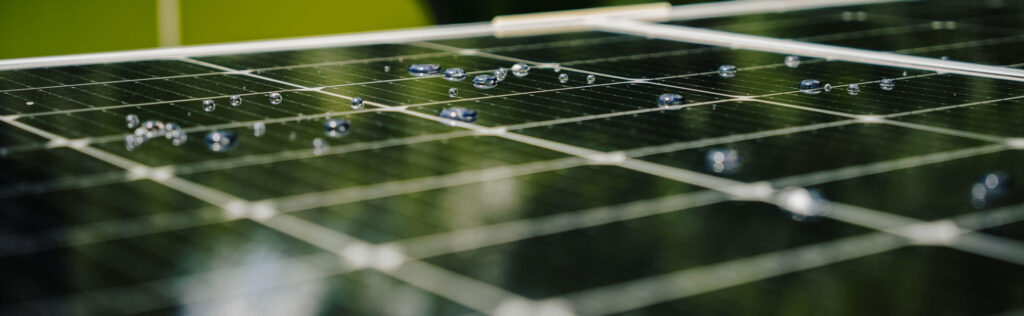
SolarCoat GC helps water bead and roll off the panel surface, supporting easier removal of dust during rainfall or cleaning.
Anti-Soiling Behavior
In the dust adhesion test, both panels were exposed to the same quantity of dust particles. The results showed a meaningful difference in how dust settled on each surface.
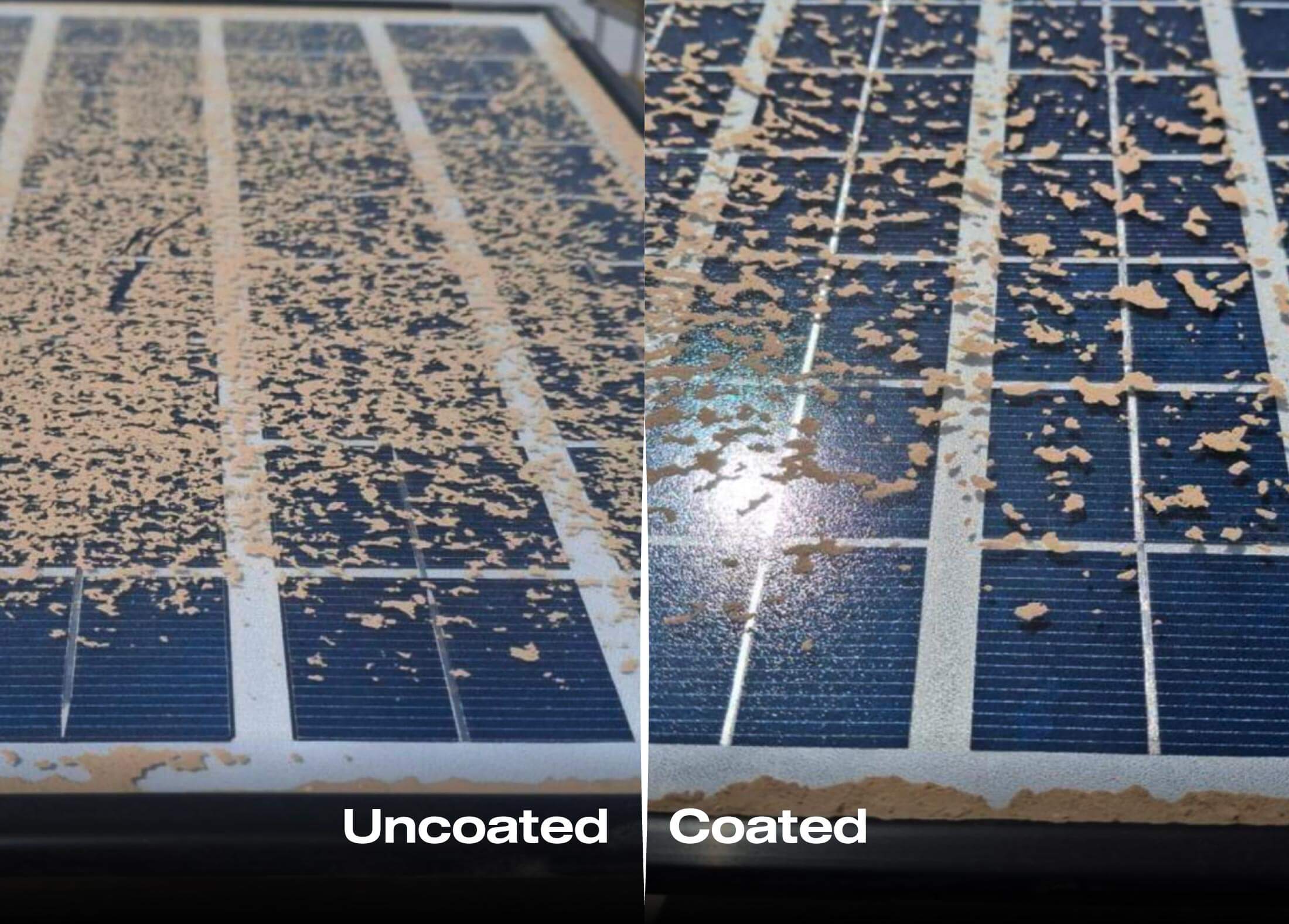
On the uncoated panel, dust formed a continuous, evenly distributed layer across the glass. On the coated panel, dust tended to accumulate in separated, uneven clusters rather than spreading uniformly. While the coating did not prevent dust from landing on the surface entirely, the reduced adhesion and less uniform distribution suggest that dust is easier to remove from a coated surface — and less likely to bond tightly to the glass.
This observation was consistent across both the controlled anti-soiling test and the 24-hour outdoor exposure test, during which both panels were left in natural outdoor conditions with sunlight, wind, and airborne dust. After 24 hours, the coated panel continued to show less uniform dust attachment compared with the uncoated reference.
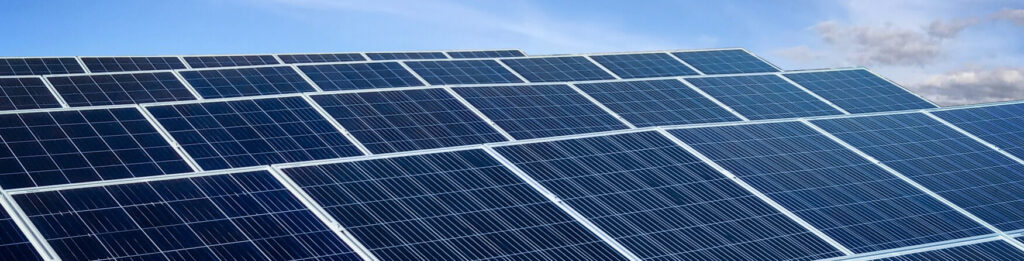
The coated surface showed reduced dust adhesion compared with the untreated panel, helping the surface remain easier to clean.
Electrical Performance: The Numbers
The most quantifiable evidence came from the electrical measurements. Across all eight tested soiling levels, the SolarCoat GC-coated panel consistently produced higher output power than the uncoated panel.
| Soiling Level | Uncoated Power (W) | Coated Power (W) | Improvement |
| 10% | 10.455 | 12.213 | 16.81% |
| 10% | 10.250 | 11.799 | 15.11% |
| 30% | 9.840 | 11.385 | 15.70% |
| 40% | 8.610 | 10.971 | 27.42% |
| 50% | 7.790 | 9.315 | 19.58% |
| 60% | 6.560 | 7.866 | 19.91% |
| 70% | 5.535 | 6.003 | 8.46% |
| 80% | 4.715 | 5.175 | 9.76% |
Average power improvement: 16.59% Peak improvement: 27.42% at 40% soiling
The data shows that soiling primarily affects the current generated by the panels — voltage remained essentially constant throughout the test, while current dropped significantly as soiling increased. This is consistent with established PV physics: dust reduces light transmission, which reduces photon-to-electron conversion, which reduces current. The coated panel maintained higher current output at every level because less dust adhered uniformly to its surface.
Economic Evaluation
The research team also conducted an economic analysis using the 41.6 kW rooftop PV installation at the Faculty of Engineering at Tafila Technical University as a reference case. The system comprises 160 panels rated at 260 W each, with a total panel surface area of approximately 256 m².Quotations for conventional manual cleaning were obtained from three local service providers in Jordan, yielding an average cleaning cost of approximately 145 JOD per cycle.
| Maintenance Scenario | Cleanings per Year | Estimated Annual Cost |
| Low-frequency (every 3 months) | 4 | 580 JOD/year |
| Typical operation (every 2 months) | 6 | 870 JOD/year |
| Intensive maintenance (monthly) | 12 | 1,740 JOD/year |
For SolarCoat GC, the estimated application cost is approximately 5.5 JOD/m², with an expected service life of three years. For the 256 m² system, this translates to:
- Total application cost: 1,408 JOD
- Annualized cost: ~469 JOD/year
The annualized nano-coating cost was lower than every manual cleaning scenario considered — and in the case of monthly intensive maintenance, the annual cleaning cost was more than three times higher than the annualized cost of applying SolarCoat GC.
The study suggests that nano-coating may reduce dependence on frequent manual cleaning and help lower maintenance costs, especially in dusty environments where regular cleaning is required.
Note: The economic analysis is based on assumptions used in the academic study and is intended to illustrate potential cost relationships rather than guarantee specific savings.
Conclusions
The Tafila Technical University study demonstrates that Nasiol SolarCoat GC performed positively across every dimension tested:
- It increased water repellency, supporting a cleaner surface between maintenance intervals.
- It reduced dust adhesion and spread, making residual dust easier to remove.
- It maintained higher electrical output across all tested soiling conditions, with an average improvement of 16.59% and a peak of 27.42%.
- Its annualized cost compared favorably against conventional cleaning schedules in the case study scenario.
The research team acknowledged that the experiment was short-term and small-scale, and they recommend long-term field studies to evaluate coating durability under extended real-world conditions. Within the scope of the study, however, the results position SolarCoat GC as a promising passive nano-coating solution for photovoltaic installations in dusty environments — particularly across the Middle East, North Africa, and other arid regions where soiling is a persistent operational challenge.
Study conducted by Mohammad Jibril AL-Arni and Ayman Ihssan Ghanem, supervised by Dr. Salman K. AL-Harasis, Tafila Technical University, Department of Electrical Power Engineering, June 2026. Nano-coating materials provided by Nasiol. Distributed in Jordan by Zain Green Technology.
The full academic report and research cooperation certificate are available for download below.