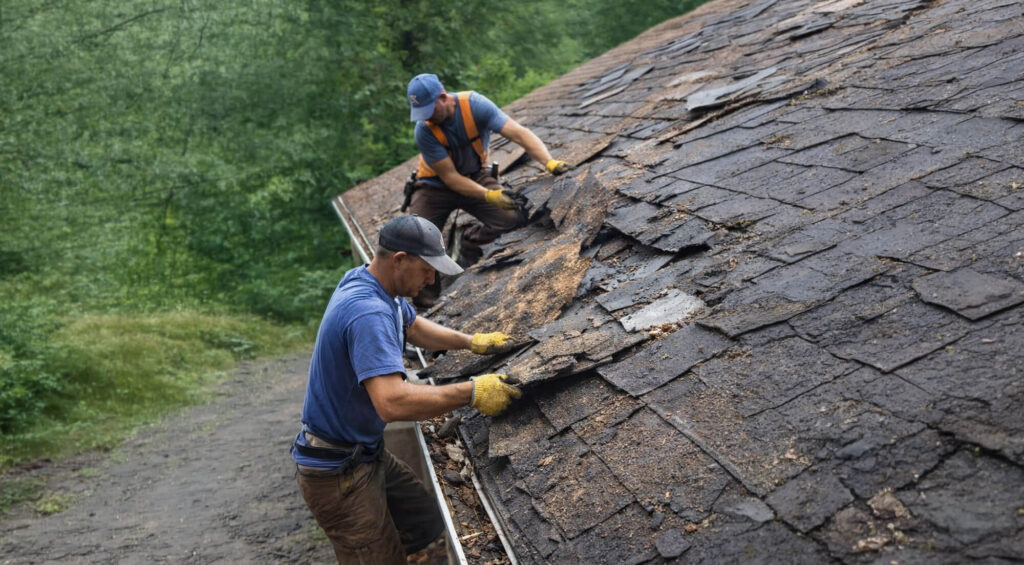
Every year, millions of roofs across North America and Europe are replaced before the end of their true technical lifetime. The materials are torn off, loaded into skips, and hauled to landfill sites where they will sit, largely unchanged, for centuries. The new materials that replace them carry their own embedded carbon cost, quarried, processed, transported, and installed, before the cycle begins again.
This is not an inevitable feature of building maintenance. It is, in large part, a material science problem with a preventive solution. Understanding why roofing surfaces fail prematurely, the actual molecular and structural mechanisms behind asphalt shingle degradation, reveals a clear intervention point. That intervention point is protective surface treatment applied early, applied correctly, and formulated to work with the material rather than simply coating over it.
This article examines the problem of premature roof failure through the lens of surface chemistry and environmental physics, explores the consequence chain from molecular degradation to structural loss to environmental impact, and explains how advanced nano coating technology, specifically Nasiol’s Z Series for mineral surfaces, interrupts that chain before irreversible damage occurs.
The Problem: Why Roofing Surfaces Fail Before Their Time
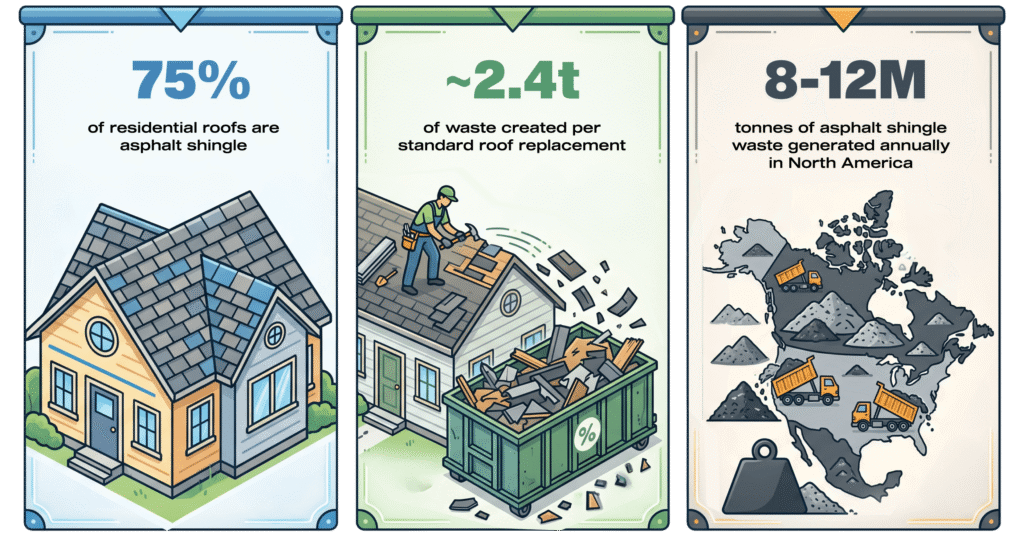
Asphalt shingles are the dominant roofing material across North America, covering roughly 75 percent of all residential structures. They are valued for their balance of affordability, ease of installation, and reasonable durability under standard conditions. Yet the gap between their theoretical service life and their actual replacement cycle is significant, and that gap is not random.
The stated design life of a standard three-tab or architectural asphalt shingle is typically quoted at 20 to 30 years. In practice, the majority of shingle roofs in moderate to harsh climates are replaced within 12 to 17 years. In high-UV environments, humid coastal regions, or areas subject to freeze-thaw cycling, that figure can fall even lower.
The primary drivers of this accelerated degradation are not structural failures in the shingle matrix itself. They are surface-level processes, ultraviolet photo-oxidation, biological colonization, moisture infiltration, and thermal cycling, that progressively compromise the surface layer until the material beneath becomes vulnerable. Because these processes are gradual and cumulative, the damage often appears invisible until it has already passed the point where targeted surface protection would be straightforward to apply.
This is the central problem: the window for effective preventive treatment is wide, but the signals that alert property owners to act tend to arrive only after significant degradation has already occurred. By the time algae staining, granule loss, cracking, or surface brittleness become visible, the material has often lost a substantial portion of its service life.
The question that shapes the rest of this article is therefore not “when should a roof be replaced?” but “at what point in the degradation cycle does a protective treatment change the outcome — and what is the material science behind that protection?”
The Mechanism: How Environmental Forces Break Down Asphalt Shingles
Understanding why roofs fail early requires understanding what asphalt shingles are, chemically and physically, and what happens to that chemistry under sustained environmental exposure.
The Structure of an Asphalt Shingle
A standard asphalt shingle consists of three primary layers. The base is a fiberglass or organic felt mat that provides tensile strength and dimensional stability. This mat is saturated with asphalt, a viscoelastic hydrocarbon mixture derived from petroleum refining, which acts as the primary waterproofing agent and structural binder. The surface is then coated with ceramic-coated mineral granules, which serve two functions: they absorb and scatter incoming ultraviolet radiation before it reaches the asphalt beneath, and they provide the shingle’s color and surface texture.
The integrity of the entire system depends on the quality of the asphalt binder and the continuity of granule coverage. When either is compromised, the degradation cascade begins.
Photooxidation: The Primary Degradation Mechanism
The most significant and least reversible driver of asphalt shingle deterioration is ultraviolet radiation. UV light, specifically the UV-A and UV-B bands, carries sufficient photon energy to break the carbon-carbon and carbon-hydrogen bonds within asphalt’s complex hydrocarbon chains. This process, known as photooxidation, does not require direct damage to the granule layer to begin; even diffuse and reflected UV contributes to cumulative exposure.
As photooxidation progresses, two things happen simultaneously. First, the volatile aromatic compounds and plasticizers embedded in the asphalt matrix — the molecules that maintain its flexibility and viscoelastic properties — are driven off through both oxidation and thermal volatilization. Because these compounds are what keep asphalt supple under thermal cycling, their loss causes the binder to become progressively harder and more brittle. Second, the oxidation products that form in their place — primarily carbonyl and sulfate groups — alter the surface chemistry of the asphalt, making it more hydrophilic (water-attracting) at precisely the moment when waterproofing protection is most needed.
The result of this dual process: UV exposure → bond breakage → volatile loss → embrittlement → surface oxidation → increased water absorption → accelerated granule detachment → further UV penetration → deeper asphalt degradation. Each step in this chain amplifies the rate of the next.
Granule Loss and Its Feedback Effect
Mineral granules are the shingle’s primary UV defense. As the asphalt binder oxidizes and loses its adhesive properties, the bond between the granule layer and the asphalt substrate weakens. Granules begin to detach — a process observable in gutters and downspouts as the dark, sand-like sediment that accumulates during rain events. This granule loss is not cosmetic. Each area of granule detachment directly exposes the asphalt below to unfiltered UV radiation, accelerating photooxidation in precisely those spots and creating a positive feedback loop: more oxidation leads to more granule loss, which leads to more oxidation.
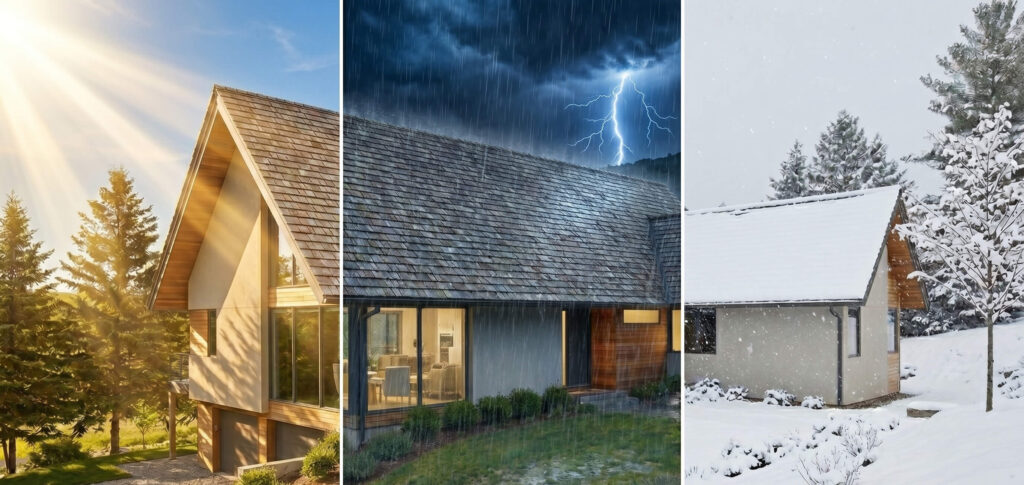
Thermal cycling compounds this effect. Asphalt shingles expand during heat exposure and contract as temperatures fall. Over thousands of daily thermal cycles across a roof’s service life, this mechanical stress creates micro-fractures in the surface — a pattern sometimes described as craze-cracking — that further disrupts granule adhesion and opens pathways for moisture infiltration.
Biological Colonization: The Underestimated Accelerant
Alongside UV degradation, biological colonization — the growth of algae, moss, and lichen on roofing surfaces — represents a distinct but interacting degradation pathway that is often underestimated in discussions of roof service life.
The most common colonizing organism on asphalt shingles in humid environments is Gloeocapsa magma, a cyanobacterium that produces dark brownish-black pigmentation as a protective response to UV exposure. This pigmentation is what causes the streaking and discoloration commonly observed on shaded or north-facing roof sections. Beyond aesthetics, the biological matter itself contributes to surface degradation through several mechanisms.
Algae colonies retain moisture against the shingle surface, extending the period of water contact that would otherwise be minimized by the roof’s natural drainage angle. Lichen, a more structurally complex organism, can physically penetrate the granule layer with rhizine structures that mechanically displace granules as the lichen grows and contracts. Moss accumulation, particularly in gutters and at horizontal roof joints, creates ponding zones where water stands rather than drains, increasing the risk of freeze-thaw damage in colder climates.
As a result, biological colonization on roofing surfaces should be understood as an accelerant rather than a separate issue: it amplifies moisture-related degradation, contributes to granule loss, and creates conditions that favor further biological growth. Treated early, it is preventable. Established, it requires intervention before surface protection can be effectively applied.
Moisture Infiltration: The Final Stage
When photooxidation has sufficiently embrittled the asphalt surface, and when granule loss has opened exposure pathways, moisture begins to penetrate the shingle body itself. This is the transition from surface degradation to structural failure. Water absorbed into the shingle matrix undergoes freeze-thaw cycling in colder climates, with each expansion of freezing water widening existing micro-fractures. In warmer, humid climates, persistent moisture within the shingle creates conditions for subsurface biological growth and accelerates the chemical breakdown of the remaining asphalt binder.
Once moisture infiltration is established, the damage becomes structural rather than cosmetic, and the options narrow accordingly.
The Consequence: What Premature Roof Failure Actually Costs
The consequences of this degradation cascade extend well beyond the property owner’s repair budget. They accumulate across three distinct cost categories: financial, environmental, and carbon.
The Financial Cost of Premature Replacement
A full residential roof replacement in North America typically costs between $8,000 and $25,000 depending on roof area, material specification, and regional labor rates. When that replacement occurs five to ten years ahead of the material’s true technical end-of-life, the financial waste is proportional to the remaining service potential of the existing roof.
For commercial properties, institutional buildings, and multi-family housing, these figures scale substantially. A flat-rate figure obscures the real cost calculation, which should account for the life-years of performance remaining in the existing material at the point of replacement.
The secondary financial costs — interior water damage during the failure period, disruption to occupants, scaffolding and access costs — add to the direct replacement figure in ways that rarely appear in quoted estimates.
The Environmental Cost: Construction Waste at Scale
Roofing is one of the most significant contributors to construction and demolition waste streams. In North America, asphalt shingle waste accounts for an estimated 8 to 12 million tonnes per year. The majority of this material goes directly to landfill, where asphalt shingles decompose on a timescale measured in centuries, not decades.
Each standard residential roof replacement generates approximately 2.4 tonnes of waste material — old shingles, underlayment, packaging, and associated debris. Multiplied across the millions of roofs replaced annually, a significant proportion of which are replaced prematurely, the cumulative landfill burden is substantial.
This is a problem that is structurally different from, for example, consumer packaging waste, because each individual event generates a large and concentrated waste stream, and because the replacement cycle is driven not by material failure per se but by surface degradation that, in many cases, is preventable or delayable through appropriate surface treatment.
The industrial equivalent of this problem is well understood in sectors such as infrastructure coating, marine anti-fouling, and architectural facade protection, where preventive surface treatment is standard practice precisely because the cost of substrate replacement far exceeds the cost of periodic surface maintenance. The roofing sector, particularly the residential segment, has been slower to adopt this logic — but the material science case for doing so is identical.
The Carbon Cost: Embedded Emissions Across the Replacement Lifecycle
The carbon cost of a roof replacement is rarely discussed in the context of home ownership or property management, but it is measurable and significant. The production of asphalt shingles is an energy-intensive process: raw asphalt must be refined, modified, and processed; fiberglass or felt base mats must be manufactured; ceramic granule coatings must be applied. Published lifecycle assessments indicate that asphalt shingle production generates between 350 and 500 kilograms of CO₂ equivalent per tonne of material.
350-500 kg of CO₂ is emitted per tonne of asphalt shingle production. A full roof replacement can account for 3 to 5 tonnes of CO₂ emissions when manufacturing, transportation, removal, and reinstallation are factored together.
A full roof replacement — accounting for new material production, transportation to site, removal and disposal of existing shingles, and reinstallation — generates an estimated 3 to 5 tonnes of CO₂ equivalent in total. To contextualize that figure: 3 to 5 tonnes of CO₂ is approximately equivalent to the annual carbon footprint of driving a mid-size passenger vehicle, or of a transatlantic return flight for two passengers.
Preventing a single premature roof replacement therefore delivers a carbon saving of that order of magnitude. Across the millions of roofs replaced prematurely each year in North America alone, the aggregate carbon opportunity of extending service life through preventive surface protection is substantial — and measurable against climate targets in a way that few other building maintenance decisions can match.
The Mitigation: How Nano Coating Technology Interrupts the Degradation Chain
The degradation mechanisms described in Part 2 — photooxidation, granule detachment, biological colonization, moisture infiltration — are sequential and interdependent. This matters for mitigation strategy because it means that intervening at any point in the chain reduces the rate of all subsequent steps, and that intervening early in the chain has a disproportionately large effect on overall outcome.
Nano coating technology, applied to roofing surfaces at the appropriate point in their service life, operates as exactly this kind of upstream intervention.
What Nano Coatings Do at the Surface Level
A nano coating is not a paint, a sealant, or a film in the conventional sense. It is an ultra-thin molecular layer — typically measured in nanometers — that bonds directly to the substrate surface through chemical interaction with the surface chemistry of the material. Because the coating operates at this scale, it does not alter the visual appearance of the surface, does not add meaningful weight or thickness, and does not impede the natural vapor transmission of the substrate. These properties are critical in a roofing context, where any treatment that traps moisture within the shingle structure would accelerate rather than prevent degradation.
The primary function of a hydrophobic nano coating on asphalt shingles is to create a high-contact-angle surface — one on which water forms near-spherical droplets and rolls off the surface rather than spreading, penetrating, or pooling. This behavior, sometimes described as the lotus effect in surface chemistry literature, is achieved through the alteration of surface energy at the nanoscale. By dramatically reducing the affinity of the roof surface for water, the coating interrupts the moisture retention cycle that enables both biological colonization and freeze-thaw damage.
A properly formulated oleophobic and hydrophobic nano coating for mineral surfaces also reduces the adhesion of airborne particulates, organic debris, and the biological spores that initiate algae and lichen colonization. Because the surface energy is low, contaminants are less likely to establish and more likely to be removed by rainfall. This is the mechanism behind the self-cleaning behavior observed on nano-coated surfaces — it is not that the coating cleans the surface, but that the surface’s altered chemistry makes retention of contaminants structurally unfavorable.
The Role of UV Blocking in Surface Protection
Advanced nano coatings formulated for exterior mineral surfaces can also incorporate UV-blocking chemistry — molecular components that absorb incoming UV radiation at the surface layer, reducing the photon energy available to initiate photooxidation in the asphalt below. This UV mitigation does not replace the protection provided by the granule layer, but it supplements it, effectively adding a secondary UV defense at the outermost surface of the system.
Because photooxidation is the primary driver of volatile loss and embrittlement in asphalt shingles, reducing UV penetration even partially slows the rate at which the binder loses its plasticizing compounds. The practical implication is that the shingle retains its flexibility and adhesive properties — including its ability to retain granules — for a longer period, which in turn delays the positive feedback loop between granule loss and accelerated UV degradation described in Part 2.
The Role of UV Blocking in Surface Protection
Any protective treatment applied to a roofing surface must preserve the vapor permeability of the substrate. Asphalt shingles naturally allow a small but meaningful level of vapor transmission, which prevents moisture from accumulating within the shingle structure or the roof assembly below. A coating that seals this vapor pathway would trap moisture, accelerating the degradation it is intended to prevent.
This requirement distinguishes professional-grade nano coatings from simpler film-forming products such as acrylic roof coatings or bituminous sealants. A nano coating applied at the molecular scale to mineral surfaces leaves the micro-porosity of the substrate intact, allowing vapor to diffuse through while presenting a hydrophobic barrier to liquid water. This is not a commercial claim — it is a direct consequence of the coating’s nanoscale architecture, and it is why substrate breathability is one of the key technical criteria in formulating nano coatings for mineral and absorbent surfaces.
The Role of UV Blocking in Surface Protection
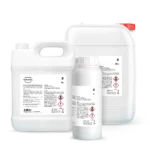
Nasiol Z-WB is the water-based formulation within Nasiol’s Z Series — a line of industrial nano coatings developed specifically for absorbent mineral surfaces, including asphalt shingles, clay and concrete tiles, and stone shingles. The Z Series was developed through Nasiol’s R&D program at the Artekya Technology facility in Gebze, Turkey, and is now used in roofing applications across more than 140 countries.
The water-based formulation carries specific technical advantages relevant to roofing applications. Unlike solvent-based alternatives, Z-WB does not produce hydrocarbon runoff during or after application, eliminating the risk of soil contamination and vegetation damage in the immediate surroundings of the treated building. It is a low-VOC product, compliant with REACH certification standards, which is increasingly a requirement for commercial and institutional roofing contracts where environmental compliance documentation is mandatory.
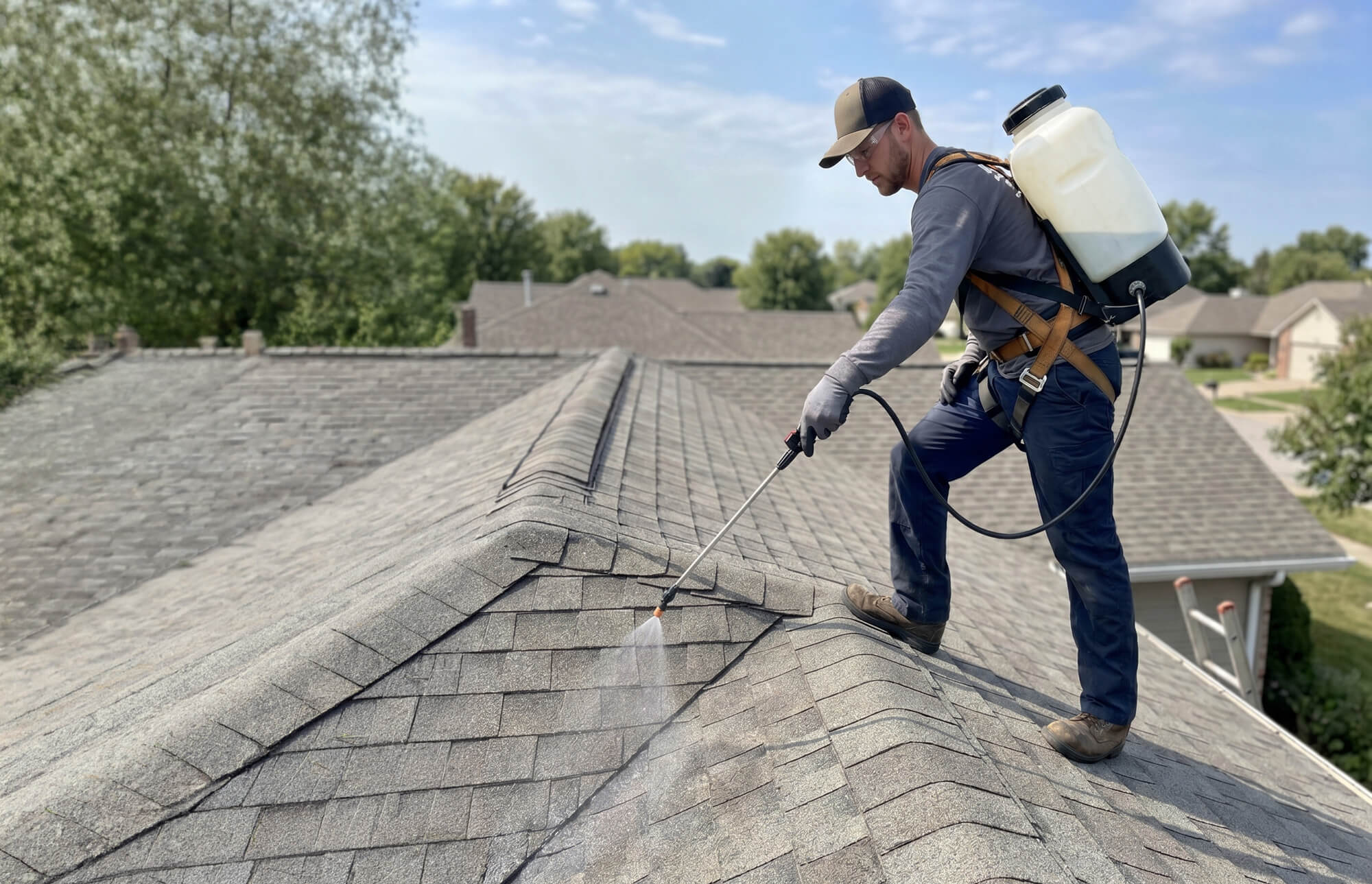
Once applied using an HVLP spray system — the recommended application method for ensuring homogeneous coverage across complex roof surfaces — Z-WB forms an invisible hydrophobic and oleophobic layer that bonds to the mineral surface. The product’s consumption rate of approximately 60 to 90 millilitres per square metre is designed to provide complete surface coverage without excess material buildup. At this coverage rate, a 200-square-metre residential roof requires between 12 and 18 litres of product — a scale of application that is straightforward for a professional roofing contractor with standard spray equipment.
The protective properties of Z-WB address each of the primary degradation vectors identified in Part 2. Water repellency reduces moisture retention and interrupts the biological colonization cycle. Oleophobicity reduces the adhesion of airborne organic particulates. The invisible surface layer reduces the rate of surface contamination without altering the visual character of the shingle surface. And because the coating preserves the natural breathability of the mineral substrate, it does not create a moisture trap within the shingle body or the roof assembly.
Applied to a roof that is in sound structural condition — typically in the 3 to 10 year range after installation, before significant granule loss or shingle embrittlement has occurred — Z-WB treatment represents a targeted intervention at the earliest stages of the degradation chain described in this article. This timing is significant: early-stage treatment addresses the surface conditions before the positive feedback loops between UV damage, granule loss, and moisture infiltration have had the opportunity to establish themselves.
For aging roofs where some degradation has already occurred, the treatment continues to provide meaningful protection for the remaining sound material, reducing the rate of further deterioration and potentially extending the functional service life of the existing structure by years beyond what would otherwise be achievable.
Cross-Industry Relevance: A Principle with Broader Application
The logic of preventive nano coating treatment for roofing surfaces is not unique to the residential sector. It reflects a principle that is well established in industrial and architectural surface protection: that maintaining a barrier at the outermost surface of a material system is orders of magnitude more efficient, less costly, and less environmentally damaging than allowing substrate degradation to proceed until structural replacement becomes necessary.
In industrial settings — chemical processing facilities, marine infrastructure, bridges, and facades — this principle is applied through anti-corrosion coatings, anti-fouling treatments, and hydrophobic surface protection as standard practice. The fact that the same material science logic applies to residential and commercial roofing surfaces reflects not a difference in the physics, but a difference in the historical expectations of the roofing market.
As sustainability requirements in building codes, green certification standards (such as LEED and BREEAM), and carbon reporting frameworks increasingly require documentation of whole-life environmental performance, the case for preventive surface treatment as a formal maintenance strategy is strengthening. The ability to demonstrate a measurable extension of roof service life — and the associated reduction in replacement-cycle carbon and waste — has direct relevance to sustainable building certification, environmental, social, and governance (ESG) reporting for commercial property owners, and the broader agenda of reducing construction waste in the built environment.
Frequently Asked Questions
At what point in a roof’s life should nano coating treatment be applied?
The optimal window for applying a hydrophobic nano coating to asphalt shingles is during the early-to-mid portion of the roof’s service life, typically between 2 and 10 years after installation. During this period, the granule layer is still largely intact, the asphalt binder retains its flexibility, and the surface has not yet developed significant photooxidation damage. Treating at this stage provides the greatest protection against the degradation mechanisms described above. For older roofs, treatment is still beneficial in protecting the remaining sound material, but the expected extension of service life will be proportionally shorter because some degradation will already have occurred.
Does nano coating on roofing surfaces affect the shingle’s ability to breathe?
A correctly formulated nano coating for mineral surfaces operates at a molecular scale and does not block the micro-porosity of the substrate. Vapor can continue to diffuse through the treated surface, preventing moisture from accumulating within the shingle structure. This is a fundamental requirement for any protective treatment on roofing materials, and it is a key technical differentiator between nano coatings and film-forming products such as acrylics or bituminous sealants, which can impair vapor transmission. Nasiol Z-WB is specifically formulated to maintain substrate breathability while providing hydrophobic and oleophobic surface protection.
How does biological growth — algae, moss, and lichen — damage asphalt shingles structurally?
Biological colonization on roofing surfaces creates damage through two primary mechanisms. First, algae and moss retain moisture against the shingle surface, extending water contact time and increasing the risk of moisture infiltration and freeze-thaw damage. Second, lichen structures physically penetrate the granule layer, mechanically displacing granules as the organism grows and contracts. Because granule coverage is the primary UV defense for asphalt shingles, any granule loss accelerates the photooxidation cycle in exposed areas. A hydrophobic, low-energy surface created by nano coating treatment reduces the likelihood of biological colonization by eliminating the moisture retention conditions and surface adhesion characteristics that favor the establishment of these organisms.
What is the connection between roof replacement rates and carbon emissions?
The full lifecycle of a roof replacement — including new material manufacturing, transportation, removal of existing materials, and reinstallation — generates an estimated 3 to 5 tonnes of CO₂ equivalent. This figure accounts for the energy intensity of asphalt shingle production (approximately 350 to 500 kilograms of CO₂ per tonne of material) as well as the logistics and labor involved. Each premature roof replacement — one that occurs before the material’s true technical end-of-life — represents that full carbon cost incurred unnecessarily. At the scale of millions of annual replacements in North America alone, the aggregate carbon impact of premature roof replacement is a significant and largely unquantified contributor to the construction sector’s climate footprint.
Can nano coating treatment reduce roofing waste going to landfill?
Yes, directly. The mechanism is straightforward: if nano coating treatment extends the functional service life of an asphalt shingle roof by several years — by slowing the UV degradation, moisture infiltration, and biological colonization processes described in this article — the number of replacement cycles over a building’s lifetime decreases proportionally. Each replacement cycle that is avoided prevents approximately 2.4 tonnes of shingle waste from entering the waste stream. At the scale of a portfolio of commercial or institutional buildings, the waste reduction potential of a systematic preventive surface protection program is material and documentable.
Is Nasiol Z-WB safe for use around vegetation and water systems?
Nasiol Z-WB is a water-based, low-VOC formulation with REACH compliance certification. Unlike solvent-based or oil-based alternatives, it does not produce hydrocarbon runoff during application or as a consequence of rain washing the treated surface. This makes it suitable for use on buildings in close proximity to gardens, drainage systems, and water features without risk of soil or surface water contamination.
How does Nasiol Z-WB compare in performance to solvent-based roof coatings?
The primary distinction is not in the protective mechanism — both aim to create a hydrophobic surface — but in the environmental profile, the application logistics, and the behavior of the product after application. Solvent-based coatings carry higher VOC loads, present greater environmental risk from runoff, and in some climates can affect surrounding vegetation during application. Nasiol Z-WB‘s water-based chemistry eliminates these risks while delivering equivalent surface protection for the target substrate materials — asphalt shingles, clay tiles, concrete tiles, and stone shingles.
Conclusion: Prevention Is the Highest-Value Intervention
The case made in this article is not primarily about a product. It is about the logic of where and when to intervene in a material degradation process that, left unaddressed, generates substantial financial waste, landfill burden, and carbon emissions — and that can be significantly slowed by a well-timed, well-formulated surface treatment.
The science of asphalt shingle degradation is well understood. Photooxidation breaks down the hydrocarbon binder. Volatile loss causes embrittlement. Granule detachment exposes the substrate to accelerated UV damage. Moisture infiltration and biological colonization compound these effects. The entire cascade, once established, is difficult and expensive to reverse.
What nano coating technology offers is an interruption of that cascade at its earliest, most accessible stage — the surface. By altering the surface energy of the mineral roofing material, a hydrophobic, oleophobic nano coating changes the fundamental interaction between the substrate and its environment: water rolls off rather than absorbing, contaminants fail to adhere, biological colonizers find no moisture to establish, and UV radiation is partially mitigated at the outermost layer.
Nasiol’s Z-WB formulation delivers this intervention in a water-based, REACH-compliant format designed for professional application across asphalt shingles, clay and concrete tiles, and stone shingles. Applied within the optimal treatment window, it represents one of the highest-value maintenance decisions available for any mineral-surface roof system — not because it replaces the need for structural inspection and maintenance, but because it extends the period over which the existing material continues to perform its intended function.
Less waste. Less carbon.
More efficiency. That’s what protection means.
Related reading: [Article #6 — Understanding Hydrophobic Surface Technology: Contact Angle, Surface Energy, and Real-World Performance] | [Article #9 — Sustainable Building Maintenance: How Preventive Surface Protection Reduces Whole-Life Carbon]