

Almost every workshop has one: a spray can on the workbench, used on hinges, bolts, tools and anything that squeaks or looks ready to rust. For decades, water-displacing sprays have been the first answer to moisture on metal, and for many small jobs they do exactly what they promise. Yet in manufacturing, construction and infrastructure, the same story keeps repeating. Parts are sprayed or oiled at the factory and still arrive at the customer with rust spots. Bolts on an outdoor structure are treated during installation and still streak brown after one wet season. Furniture legs leave the plant clean and come back as warranty claims.
The reason is not poor application or bad luck. It comes down to a simple question that is rarely asked: what is actually left on the metal after spraying, and how long does it stay there? This article answers that question from the chemistry upward. It explains how atmospheric corrosion starts, what a water-displacing film can and cannot do, what “temporary” protection really costs an industrial operation, and how bonded nano coatings such as Nasiol MP55 approach the problem in a different way.
Key takeaways
- A water-displacing spray leaves a soft oil or wax film that rests on the metal. Its own reference documents describe the protection as short term and require it to be renewed.
- Rust needs a thin film of moisture and salts on the surface. The most direct protection keeps that electrolyte from wetting the metal.
- A bonded nano coating such as Nasiol MP55 cures into a dry, transparent 600-800 nm film that repels water and oil, so it stays clean and leaves no oily residue to remove before assembly.
- The practical rule: coat what stays still; lubricate what moves.
Part 1 / The problem
Rust That Appears After the Metal Was “Protected”
The pattern is familiar to anyone who handles metal parts at scale. Profiles, pipes, brackets and fasteners are given a protective spray or a light oil before storage or dispatch. Weeks later, at a warehouse, on a building site or at a customer’s assembly line, they show flash rust on steel, white powdery corrosion on aluminium or galvanized surfaces, and brown spots around threads and cut edges. The batch is rejected, reworked or accepted with a complaint. Even when no rust appears, the parts often arrive greasy and dusty, and the customer has to clean them before use.
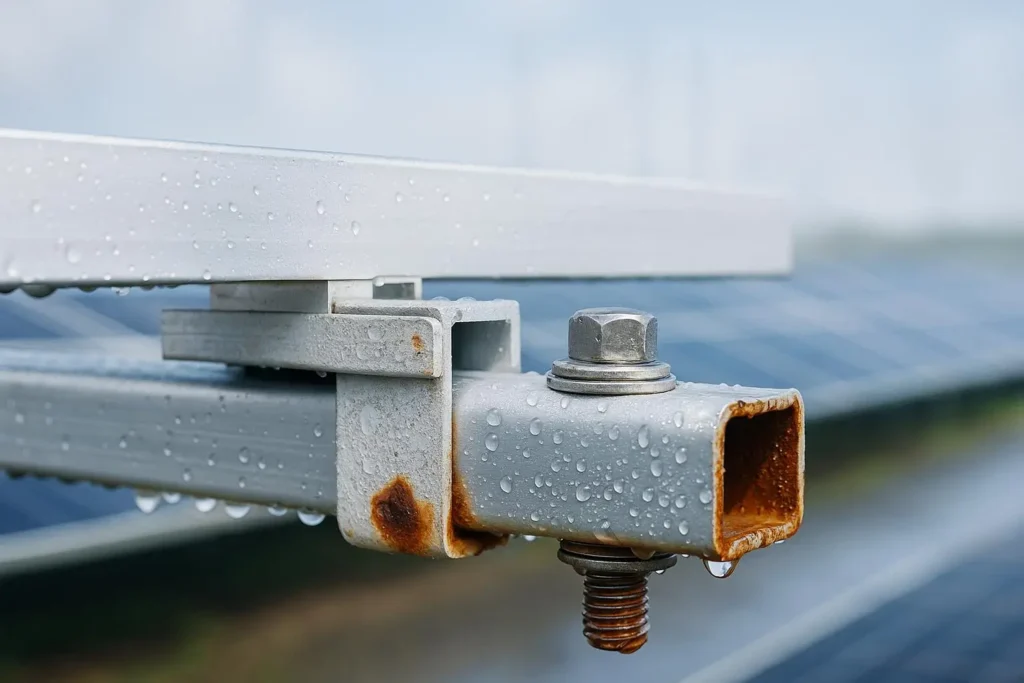
The surprise is that this outcome is not a failure of the product category. It is the product category working as designed. Water-displacing corrosion preventive compounds are a well-defined family with their own military specification, MIL-PRF-81309, which classifies them as ultra-thin-film, water-displacing corrosion preventive compounds. Most of its types are described as soft films. The joint US military corrosion-control manual for avionics and electronics equipment (NAVAIR 01-1A-509-3, also published as TM 1-1500-344-23-3) describes such compounds as providing “short term corrosion protection of metal surfaces during shipment, storage, and in-service use,” and states that “reapplication of compound is necessary after solvent cleaning or where coating has been damaged by abrasion.”
In other words, the category’s own reference documents call it short-term protection that has to be renewed. When the specification itself describes the protection as temporary, the useful question is not whether it works. It does. The useful question is how long it works, and what the repeated renewal costs.
Part 2 / The mechanism
Why Metal Corrodes, and What Each Film Does About It
How Atmospheric Corrosion Starts
Rust is not simply metal “reacting with air.” Atmospheric corrosion is an electrochemical process, and it needs three things at the same time: a metal surface, oxygen and an electrolyte. In open air, the electrolyte is a thin film of moisture on the surface, often only a few molecular layers thick and invisible to the eye.
That moisture film forms in two common ways. The first is humidity: as relative humidity rises, water adsorbs onto the metal surface, and ISO 9223 uses periods above 80% relative humidity at temperatures above 0°C as the basis for estimating a surface’s “time of wetness.” The second is condensation: when a metal part is colder than the surrounding air, its surface drops below the dew point and water condenses directly onto it.
Once the film is present, dissolved salts and pollutants make it conductive. Chlorides from sea air or de-icing salt, and sulfur compounds from industrial atmospheres, accelerate the process sharply. Small anodic areas on the surface begin to dissolve metal, neighbouring cathodic areas reduce oxygen, and the products combine into oxides and hydroxides. On steel, the result is red rust. On zinc and galvanized steel, it is white rust. On aluminium, it is a white powdery oxide and, in chloride environments, pitting.
The corrosion chain
- Humidity or a temperature swing
- A thin moisture film forms on the metal
- Salts and pollutants turn it into an electrolyte
- Current flows between anodic and cathodic sites
- Metal is lost as rust or white oxide
The cause-and-effect chain is therefore short and predictable: humidity or a temperature swing leads to a moisture film, salts turn that film into an electrolyte, the electrolyte allows current to flow between anodic and cathodic sites, and metal is lost. Every effective protection strategy works by breaking this chain, and the most direct way to break it is to keep the electrolyte away from the metal surface.
What a Water-Displacing Film Actually Leaves Behind
A water-displacing spray does this in a clever but limited way. The product is a light oil or wax-like compound dissolved in a volatile solvent carrier. Because the mixture has very low surface tension, it spreads quickly across the metal and creeps under water droplets, lifting them off the surface. That is the “water-displacing” action, and it is genuinely useful when a part is wet right now.
After the solvent evaporates, what remains is a soft, thin film of oil or wax. That film is physically adsorbed: it rests on the surface and clings to it, but nothing chemically anchors it to the metal. Therefore it behaves like any loose film. It slowly evaporates, it wipes off on hands, gloves and packaging, it washes off in rain or cleaning, and it drains from vertical surfaces over time. As the film thins, the bare metal is exposed again, and the corrosion chain restarts from the first step.
There is a second effect that matters as much as the first. An oil film is oleophilic, meaning it attracts and holds other oily and organic matter. Dust, metal fines, fingerprints and airborne grime stick to it readily. This is why oiled parts so often come out of storage looking dirty, and why that dirt can itself hold moisture against the surface.
It is worth being precise about the wider family. Penetrating oils, soft-film and hard-film rust-preventive oils, waxes and vapour corrosion inhibitor (VCI) products all belong to the broader group of short term corrosion preventives. They differ in film thickness and duration, but they share the same principle: protection lasts as long as the film is present, and the film is designed to be removed or renewed.
How a Bonded Nano Film Works Differently
A bonded nano coating approaches the same problem from the opposite direction. Instead of leaving a soft layer that rests on the metal, it forms an ultra-thin, dry film that bonds to the oxide layer naturally present on metal surfaces. Because the film is attached rather than merely adsorbed, it does not evaporate, drain or wipe away in normal handling, and it creates a transparent, durable barrier to water.
The film works by lowering the surface energy of the metal. A low-energy surface is difficult for liquids to wet, so water forms tight beads instead of spreading into the continuous thin layer that corrosion needs. This behaviour is measured as the contact angle, the angle a droplet makes where it meets the surface. The higher the angle, the less the liquid wets the surface. Above 90° a surface is considered hydrophobic, and the beads roll off rather than sit.
The key difference from an oil film is that a well-designed nano coating repels oil as well as water. A surface that is both hydrophobic and oleophobic gives the electrolyte nowhere to settle, and gives dirt and grease nothing to hold on to. As a result, the same physical property that slows corrosion also keeps the surface cleaner.
Part 3 / The consequence
The Hidden Cost of “Temporary”
The limits of a temporary film rarely show up in a single dramatic failure. They show up as a series of small, recurring costs that are easy to accept as normal.
Short term
Transit and storage take their toll. Parts are most exposed between the end of the production line and the moment they are installed. Sea freight containers go through daily condensation cycles, warehouses breathe humid air, and packaging traps moisture against the surface. A soft film that has already thinned through handling offers little resistance to weeks of this. The result is flash rust, white rust on bundled galvanized profiles and rejected deliveries.
The customer also inherits a cleaning step. Oiled parts must be degreased before painting, powder coating, welding, adhesive bonding or assembly. That means an extra process step, solvent or alkaline cleaner, waste handling, labour and time, all on the customer’s side. Many buyers now treat oily delivered parts as a quality problem in their own right.
Medium term
Appearance and dirt become an issue. Because oil films hold dust and fingerprints, stored parts look dirty and installed parts collect grime. For architectural metal, furniture components, visible profiles and consumer products, a greasy or smeared surface is simply not acceptable, regardless of whether rust has appeared yet.
Reapplication becomes a routine cost. A temporary film has to be renewed, and renewal by hand is inconsistent. Some areas receive too much, some too little, and recesses, threads and cut edges, which are exactly where corrosion starts, are the hardest to cover evenly.
Long term
These costs add up at a global scale. The NACE International (now AMPP) IMPACT study, published in 2016, estimated the global cost of corrosion at about US$2.5 trillion per year, roughly 3.4% of global GDP. The same study found that using available corrosion-control practices could save between 15% and 35% of that cost, or about US$375-875 billion annually. Much of that potential saving lies not in exotic new technology but in replacing protection that has to be renewed with protection that stays in place.
US$2.5 trillionestimated global cost of corrosion per year
3.4%of global GDP
15-35%could be saved with corrosion-control practices already available
Source: NACE International (now AMPP), IMPACT study, 2016.
The same physics applies well beyond the factory floor. Automotive brackets and underbody hardware, marine fittings, solar mounting structures, architectural aluminium, street furniture and electrical enclosures all face the same humidity, condensation and salt. In every one of these fields, a protective film that leaves is a film that must be replaced, and every replacement is a cost, a risk of missed areas and an interruption to normal operation.
Related reading
For how laboratory tests such as salt spray relate to real-world durability, see our article on what coating durability claims really mean.
Part 4 / The mitigation
Bonded Thin-Film Protection
The Category: Protection That Stays on the Surface
Bonded thin-film anti-corrosion coatings form a durable layer that stays on the metal for its service life, rather than a sacrificial film that is gradually consumed. They are applied as a liquid, cure into a dry and transparent film a fraction of a micrometre thick, and protect by keeping water, salt solutions and oils from wetting the surface. Because the film is dry and very thin, it does not change the appearance, colour or dimensions of the part, leaves nothing to clean off before the next process step, and does not attract dirt.
Nasiol MP55 as a Worked Example
Nasiol MP55 is an anti-corrosion nano coating for metals and alloys, developed for industrial use and supplied in 1 L, 5 L and 20 L containers. Its published technical data describe what this category of coating can do in practice:
| Property | Nasiol MP55 (catalog data) |
|---|---|
| Dry film thickness | 600-800 nm |
| Water contact angle | 106° (10 µL droplet) |
| Water sliding angle | 12° (60 µL droplet) |
| Oil contact angle | 89° (10 µL droplet) |
| Chemical resistance | pH 1 to pH 12 |
| Saltwater and moisture resistance | Yes |
| Temperature durability | Up to 275°C |
| Durability | 1 year to several years |
| Coverage | 5-8 mL/m² |
| Application | Manual or pressurized spray |
| Curing | Room temperature or high-temperature cure |
A dry film of 600-800 nm is roughly one hundredth of the thickness of a human hair, which is why coated parts look and measure the same as uncoated ones. The water contact angle of 106° places the surface clearly in the hydrophobic range, and the 12° sliding angle means droplets roll away at a slight tilt instead of sitting on the surface. The 89° oil contact angle is the figure that separates MP55 most clearly from oil-based protection: the surface resists oils almost as strongly as water, so it stays dry to the touch and does not hold grease.
Secondary benefits that users notice. Because the cured film is neither greasy nor sticky, coated surfaces gain three properties that many users value as much as the rust protection itself. First, they are easier to clean: mud, dust and road film cannot key into a low-energy surface, so they rinse away with less effort and less detergent. Second, they show anti-graffiti behaviour: spray paint and marker ink adhere poorly, so tags can be removed more easily and without aggressive solvents that could damage the metal or its finish. Third, they look cleaner for longer, because there is no oily layer for dust and fingerprints to stick to. All of these effects come from the same low surface energy that keeps the electrolyte away, which is why they appear together.
MP55 is REACH compliant, and Nasiol confirms it is safe for use on home and playground equipment.
Where graffiti is the main concern, Nasiol’s dedicated Anti-GRM anti-graffiti coating is the specialist choice; see also our article on anti-graffiti coatings for urban and public infrastructure.
Oil Film Versus Bonded Nano Film
The differences between the two categories can be summarised side by side:
| Classic water-displacing oil film | Bonded nano coating (e.g., MP55) | |
|---|---|---|
| What stays on the surface | Thin oily or waxy film | Dry, transparent nano film |
| Attachment to metal | Physically adsorbed | Bonded to the surface |
| Feel and appearance | Greasy, visible | Dry, unchanged appearance |
| Dirt and dust pickup | Attracts dirt (oleophilic) | Repels water and oil |
| Film thickness | Varies with application | 600-800 nm |
| Heat tolerance | Evaporates or degrades with heat | Up to 275°C |
| Before painting or assembly | Usually needs degreasing | No oily residue to remove |
| Renewal | Frequent | Up to 1 year of protection |
How MP55 Is Tested and Proven
There is no single salt-spray requirement that applies to every product. Different industries specify different tests and pass levels: neutral salt spray under ISO 9227 or ASTM B117 for general comparison, cyclic corrosion tests in automotive and OEM specifications, and ISO 12944 performance testing for protective paint systems. The same coating also reaches different durability levels on different metals and surface conditions, such as mill-finish versus anodized aluminium, bare versus galvanized steel, or polished versus brushed stainless steel. For that reason, Nasiol evaluates MP55 application by application, on the actual metal and surface the customer uses.
Two examples illustrate the results.
Marine application
MP55-coated covers for underwater cables completed an 18-day (432-hour) salt-spray test with a clear pass. Coated covers inspected after a full year in service were still in very good condition.
Commercial use
MP55 is an established, continuously used coating for joint rivets on outdoor metal roofs, metal furniture legs and aluminium solar-panel frames, applied by customers around the world in very different climates, from humid coastal regions to hot, dry and dusty sites.
In Nasiol’s side-by-side laboratory and field comparisons with other commercially available anti-corrosion coatings, MP55 showed markedly longer salt-spray durability. Detailed test data are available to industrial customers on request.
Real test photos
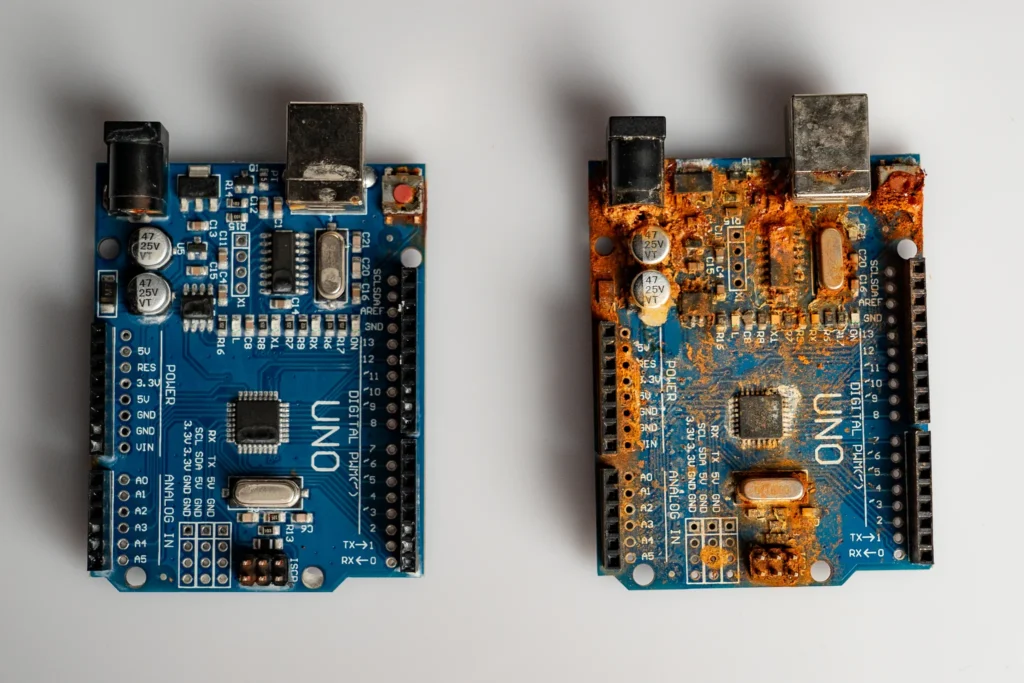
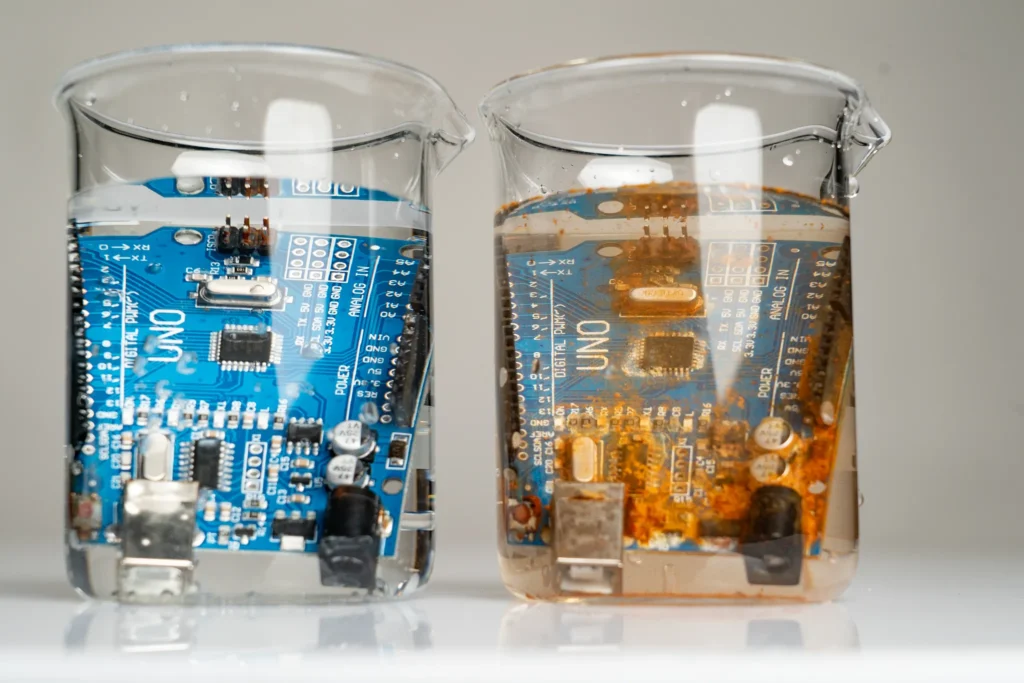
Watch the rust test
How to read salt-spray hours
Salt-spray hours are a way of comparing products under identical, deliberately harsh conditions. They do not convert directly into years of service, because the substrate, surface preparation, application quality and real environment all influence the outcome. That is why laboratory results and field experience are most convincing when they point in the same direction, as they do in the cases above.
Coat What Stays Still, Lubricate What Moves
Every protection method has a natural field of use, and the dividing line for nano coatings is motion and abrasion.
Durable hard nano coatings such as Nasiol MP55 belong on fixed metal. That means bolts and nuts that are tightened once, fixed joints and rivets, brackets, frames, profiles, posts, rails and standalone metal parts. These parts meet rain, dust, mud and humidity, but they do not rub against other surfaces, so the film stays intact and protects for its full service window.
Moving parts and parts under heavy physical abrasion are a different job. A bicycle chain, a gear set, a hinge, a sliding rail, a lock mechanism, a bearing or a playground swing chain sees constant metal-on-metal contact, which wears any thin film away in a short time. The same is true for the working edges of tools and for surfaces that are walked or slid on. For these parts, the best rust protection is still a lubricant applied frequently. A lubricant protects by being replenished rather than by staying, and that is the right mechanism for anything in motion.
This is also where water-displacing sprays keep a valid and useful place. They are well suited to simple daily jobs that need light lubrication: freeing a stuck part, loosening a seized bolt, quick maintenance in the workshop and at home. Their limit is durable rust protection, not usefulness. Two other boundaries are worth stating clearly. Parts that are already rusted need rust removal and cleaning first, because MP55 is not a penetrant or a rust converter and needs a clean, rust-free substrate. And for multi-decade protection in severe environments, such as offshore structures in ISO 12944 corrosivity category C5 or CX, heavy-duty paint systems remain the appropriate solution.
The practical rule
Coat what stays still. Lubricate what moves.
Coat: fixed metal
- Bolts and nuts tightened once
- Fixed joints and rivets
- Brackets, frames and profiles
- Posts, rails and standalone metal parts
Lubricate: moving or abraded parts
- Bicycle chains and gear sets
- Hinges, sliding rails and lock mechanisms
- Bearings and playground swing chains
- Working edges of tools, and surfaces that are walked or slid on
Outside the scope of a thin coating
- Parts that are already rusted: remove rust and clean first, since MP55 is not a penetrant or a rust converter
- Multi-decade protection in ISO 12944 category C5 or CX: heavy-duty paint systems
- Parts that run above 275°C, such as exhausts and brake components
- Weathering steel, which is designed to form its own protective patina
Where Bonded Anti-Rust Coatings Are Used
Bonded anti-rust coatings fit any fixed metal part exposed to rain, dust, mud, humidity, salt or cleaning chemicals, where protection must last and the surface should stay clean and visually unchanged. The range of applications is wide, and it covers both industrial and DIY use.
Bridges, roads and public infrastructure
On steel bridges, the bolts, nuts, washers and rivets at structural joints are often the first places where rust appears, because water collects in the crevices around their heads; a transparent film protects them without hiding them from inspectors. Along roads, guardrail and crash-barrier bolts, the base bolts and anchor plates of galvanized lighting poles, traffic-sign posts, aluminium sign frames and gantry fixings face de-icing salt and spray from passing traffic. Pedestrian-bridge handrails and stainless railings at stations are exposed to weather and touched every day, which makes the easy-clean effect useful as well.
Playgrounds, parks and street furniture
Steel and stainless playground frames, climbing structures, posts and the fixed connectors that hold them together stay outdoors all year and are washed by rain and covered by mud and sand. Outdoor fitness equipment, park benches with cast-iron or steel legs, waste bins, bollards, bicycle racks, bus-shelter frames and the fixed panels and posts of metal fences and gates belong to the same group. Street furniture is also a frequent target for graffiti, so easier removal is a direct operating benefit for municipalities.
Monuments, sculptures and heritage metal
Bronze and brass statues, commemorative plaques, stainless-steel sculptures, cast-iron fountains and lamp posts, and wrought-iron gates and railings in historic districts need protection that does not change their appearance. A transparent film with no wet or glossy look meets that requirement. Weathering steel is the exception: it is designed to form a protective rust patina and should be left to do so.
Established MP55 use
Building facades and metal roofs
Facade cladding fixings, aluminium curtain-wall, window and door profiles, louvres and sun-shading fins, metal signage letters, stainless balcony and stair railings, glass-balustrade fittings and external steel staircases all benefit from durable, invisible protection. So do gutter brackets, downpipe clips and flashings in galvanized steel, zinc or copper. On metal roofs, the joint rivets, self-drilling screws and their washers often corrode before the roof sheet itself, leaving rust streaks down the roof; this is one of MP55’s established commercial applications. Outdoor air-conditioning brackets and casings and antenna and satellite mounts complete the list.
For the roof surface itself, see why roof protection matters more than ever.
Established MP55 use
Solar energy and utilities
Aluminium solar-panel frames, mounting rails, clamps and the galvanized or stainless bolts of the support structure are exposed for decades, often at coastal, agricultural or desert sites where salt, ammonia or abrasive dust are present. Aluminium frames are another established MP55 application. Electrical cabinets, junction boxes, outdoor meter housings, cable trays, cable covers and cable protection systems, transmission and telecom tower bolts, street-lighting housings and EV-charger enclosures face the same exposure.
For the glass side of solar panels, see how to increase solar panel efficiency and longevity.
Established MP55 use
Marine and coastal environments
Underwater and splash-zone cable covers, fixed stainless deck fittings such as cleats, rails and fairleads, marina pontoon and gangway fixings, dock ladders and seafront railings and street furniture all live in chloride-laden air. Boat-trailer frames and fixed fittings, which are immersed in seawater at every launch, belong here as well.
Established MP55 use
Furniture
Legs and frames of metal tables and chairs for terraces, gardens, cafés, schools and offices are one of MP55’s most common uses, whether in chromed steel, stainless steel, aluminium or steel. Garden furniture, sun-lounger frames, umbrella bases, outdoor-kitchen frames and metal shelving in humid basements, garages and cold stores face similar conditions. Even indoors, chair and table legs meet water and detergent every time the floor is mopped, which is why their feet are usually the first part to rust.
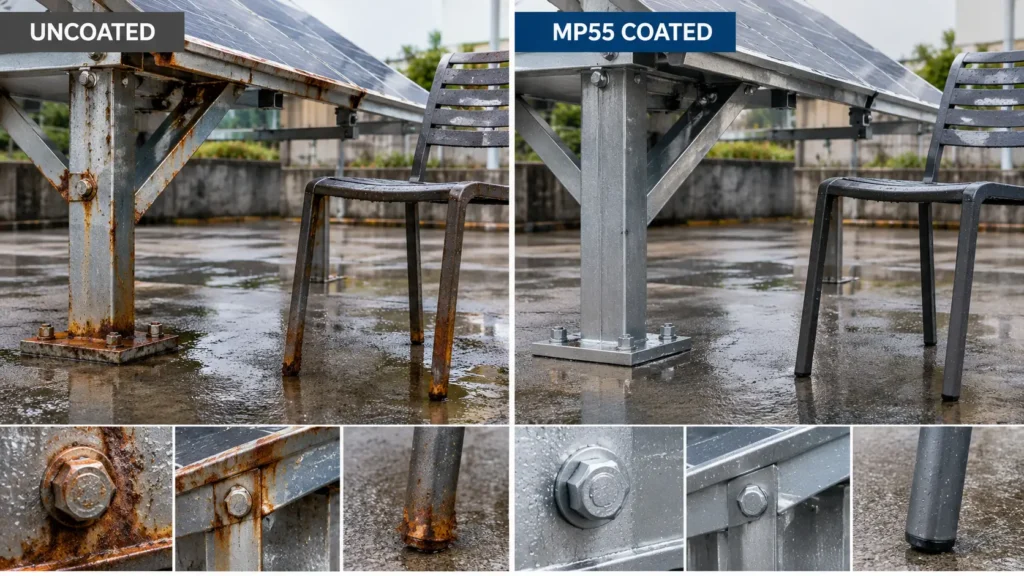
Automotive, transport and leisure
Trailer brackets and fixed bolts, tow-bar mountings, roof racks and bike carriers, licence-plate screws, caravan and camper chassis fixings, and the frame bolts, spokes and fixed fittings of motorcycles and bicycles are all fixed parts exposed to road spray. Chains, gears and cables are not, and they stay with lubricants. Parts that run above 275°C, such as exhausts and brake components, are outside the coating’s temperature range.
Agriculture, garden and home
Greenhouse steel and aluminium frames and fixings, irrigation pipe fittings and fixed valve bodies, fence posts and wire fittings, mailboxes, house numbers, outdoor lamps, outdoor taps and brass fittings, and the fixed parts of door handles and knockers are typical home and garden uses. Stored hand tools and stocks of fasteners kept in sheds and garages also benefit, as long as working edges are left to lubricants.
Industrial manufacturing
Profiles, pipes, machine and device housings, fixed machine parts, furniture components, building components and production components can be coated as a final finishing step, so they leave the factory protected through storage and transit without any oil to clean off. Spare parts and fasteners held in stock benefit in the same way.
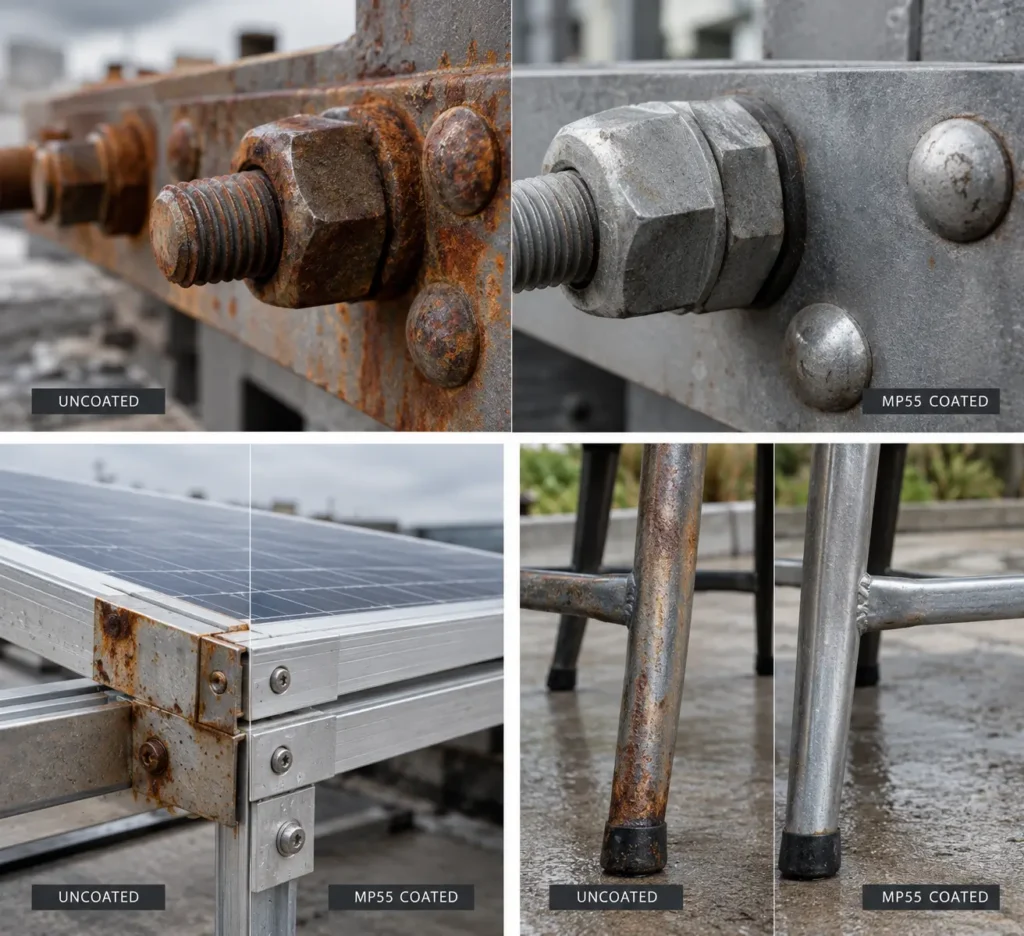
What Corrosion Looks Like, Metal by Metal
The metal involved shapes what corrosion looks like and why protection matters.
A bonded hydrophobic and oleophobic film slows all of these processes by the same principle: it keeps the electrolyte from wetting the surface.
Integration on a Production Line
For manufacturers, a bonded coating is most valuable when it can be added without rebuilding the process. MP55 is applied manually or by pressurized spray and cures either at room temperature or with a high-temperature oven cure, so it can be added as the final finishing step of an existing line. The recommended application window is 5-30°C at a relative humidity of 50% or lower, and the surface must be clean, dry and free of rust and oil before coating.
For procurement, the arithmetic is straightforward. At 5-8 mL/m², one litre covers roughly 125-200 m², and one 20 L container covers roughly 2,500-4,000 m². Because an opened container should be used within one week, container size is best matched to line throughput.
Free samples for industrial users
Test MP55 on your own parts
Nasiol also sends free samples to companies that want to test MP55 on their own parts, metals and operating conditions before committing to a change.
Conclusion
The spray can on the workbench has done its job for generations, and that job was displacement: pushing water off metal for a while, freeing stuck parts and lubricating what moves. It still does that job well. What industry increasingly needs is something different, protection that stays on, stays clean and leaves nothing to remove before the next step.
Bonded nano coatings meet that need for fixed metal parts, from bridge bolts and roof rivets to solar frames, furniture legs and cable covers. The best way to choose between protection methods is the same principle that applies to any coating: judge it by test methods, data and field results, not by habit or by what has always been on the shelf. Buy the manufacturer, not the label, and where possible, test it on your own parts.
Frequently Asked Questions
Is a water-displacing spray a coating?
Not in the sense of a lasting protective layer. A water-displacing spray leaves a soft, thin film of oil or wax that is physically adsorbed on the metal. Its own specification family describes such compounds as short-term protection that must be reapplied after cleaning or abrasion. A coating, by contrast, forms a durable film that stays on the surface for its stated service life.
Why does metal still rust after it has been sprayed with oil?
Because the oil film does not stay. It evaporates, wipes off during handling, washes off in rain and drains from vertical surfaces. Once it thins, the moisture film that drives corrosion can reach the metal again, especially during condensation in containers and warehouses. Oil films also hold dust that traps moisture against the surface.
Should moving parts such as bicycle chains and hinges get a nano coating or a lubricant?
A lubricant. Moving and heavily abraded parts wear away any thin coating through constant metal-on-metal contact. For chains, gears, hinges, rails, locks and bearings, the best rust protection is a suitable lubricant applied regularly. Durable nano coatings are intended for fixed metal parts such as bolts, rivets, frames, profiles and posts.
What is the difference between a corrosion preventive compound and an anti-corrosion coating?
A corrosion preventive compound is a temporary film, usually oil or wax based, designed to protect metal for a limited period and to be removed or renewed. An anti-corrosion coating is designed to remain on the surface and protect continuously for its service life. Bonded nano coatings belong to the second group, with a dry, ultra-thin film rather than a soft one.
Does a nano anti-corrosion coating change the appearance or dimensions of metal?
No, not noticeably. A coating such as Nasiol MP55 cures into a transparent film of 600-800 nm, roughly one hundredth of the thickness of a human hair. The part keeps its original colour, finish and dimensions, and the surface stays dry to the touch rather than greasy.
Can parts coated with Nasiol MP55 be painted, welded or assembled without cleaning?
Assembly can proceed directly, because the coating leaves no oily residue and the film is too thin to affect fits. Painting, welding and adhesive bonding are different, because a low-energy surface is designed to resist wetting, including by paints and adhesives. For parts that will be painted, welded or bonded after coating, the process should be agreed with Nasiol’s technical team in advance. We advise applying the coating as a top coat after painting or assembly.
How is salt-spray test performance measured, and what do the hours mean?
Coated test panels are placed in a chamber with a continuous salt fog, typically under ISO 9227 or ASTM B117, and inspected at intervals for rust, blistering or other defects, often rated against ISO 4628. The result is the number of hours before a defined failure appears. These hours are best used to compare products under identical conditions; they do not convert directly into years of outdoor service.
About Nasiol
Nasiol is a nano coating brand produced by Artekya Technology. Its products are built on surface chemistry rather than on cosmetic effects: the coatings are designed to bond to the surfaces they protect and to change how those surfaces interact with water, oil and dirt.
That approach is what separates nano coatings from conventional waxes and oils. A wax or oil sits on a surface and wears away. A bonded nano coating becomes part of the surface for its service life. Nasiol applies the same surface science across automotive, glass, building, roofing and solar products, and its industrial line brings it to metals, alloys and manufactured components such as those protected by MP55.
References
- MIL-PRF-81309, Performance Specification: Corrosion Preventive Compounds, Water Displacing, Ultra-Thin Film. US Department of Defense.
- NAVAIR 01-1A-509-3 / TM 1-1500-344-23-3, Cleaning and Corrosion Control, Volume III: Avionics and Electronics. Joint US Navy and Army technical manual.
- NACE International (now AMPP), International Measures of Prevention, Application, and Economics of Corrosion Technologies (IMPACT) study, 2016.
- ISO 9223, Corrosion of metals and alloys: Corrosivity of atmospheres: Classification, determination and estimation.
- ISO 9227, Corrosion tests in artificial atmospheres: Salt spray tests; ASTM B117, Standard Practice for Operating Salt Spray (Fog) Apparatus.
- ISO 4628, Paints and varnishes: Evaluation of degradation of coatings.
- ISO 12944-2, Paints and varnishes: Corrosion protection of steel structures by protective paint systems: Classification of environments.