Walk down any aisle of automotive care products, or scroll through any detailing forum, and one number dominates every ceramic coating conversation: years. Three years of protection. Five years. Some products promise a decade. The figure is printed on bottles, repeated in advertisements, and quoted by installers as if it were a physical property of the liquid itself — as fixed and measurable as its density or refractive index.
It is not. A durability rating is a prediction, and like all predictions it rests on assumptions, test methods, and interpretations that vary widely from one manufacturer to another. Two coatings both labeled “5 years” may have been evaluated by entirely different procedures — or, in some cases, by no documented procedure at all. This article explains what those year figures actually represent: how coating durability is defined, which laboratory tests generate the numbers, who sets the testing standards (and who does not), how closely accelerated results track real-world performance, and what a genuinely credible durability claim looks like.
The Number on the Bottle: A Claim Without a Common Definition
The first thing to understand about ceramic coating durability ratings is that there is no universal, regulated definition of what “durability” means. Before a year figure can mean anything, someone has to decide what counts as the coating still working — and that decision is left entirely to the manufacturer.
There are at least three reasonable definitions, and they produce very different numbers. The strictest is film presence: the coating counts as durable for as long as any measurable layer remains chemically bonded to the paint. A more practical definition is functional performance: the coating counts as alive only while it still delivers the properties the customer bought it for — active water beading, easy cleaning, gloss enhancement, and chemical resistance. The loosest definition is visual impression: the coating “lasts” as long as the car still looks good to its owner, a criterion so subjective it cannot be tested at all.
The gap between these definitions is where inflated claims live. A coating can leave detectable residue on a panel for many years after its hydrophobic behavior has collapsed. If a manufacturer quietly uses film presence as its yardstick while the customer assumes functional performance, both parties can point to the same surface and reach opposite conclusions about whether the product kept its promise. The honest position — and the one adopted by serious formulators — is the functional one: a car ceramic coating is durable only while it measurably performs. Everything that follows in this article builds on that definition.
How Coating Durability Is Actually Measured
Because “years” cannot be measured directly in a laboratory, durability testing works by measuring physical properties that decay as a coating wears, then tracking how fast that decay happens under controlled stress. Five families of tests dominate the field.
Hardness: What a Pencil Actually Tests
The famous “9H” and “10H” figures come from the pencil hardness method standardized as ASTM D3363, in which pencils of increasing graphite hardness are pushed across the cured film at a fixed angle and load until one visibly scratches or gouges it. The scale refers to pencil grades — 9H is the hardest standard drawing pencil — not to the Mohs mineral scale, and a 9H coating is emphatically not “almost as hard as diamond,” a comparison that still circulates in marketing copy. Pencil hardness says something useful about resistance to light marring, but it is a single-point snapshot of a freshly cured film. It says nothing about how long the coating survives, which is why hardness figures and durability figures should never be treated as interchangeable.
Weathering: Compressing Sunlight into Weeks
Ultraviolet radiation slowly breaks chemical bonds in any organic or hybrid coating. To simulate years of sun in a practical timeframe, laboratories use accelerated weathering chambers: fluorescent UV instruments run under ASTM G154, and xenon-arc instruments — whose spectrum more closely matches full sunlight — under ISO 4892 or ASTM D6695. Panels cycle through programmed periods of intense UV, elevated temperature, humidity, and water spray. The critical, and most debatable, step is conversion: a manufacturer must decide how many chamber hours equal one outdoor year. That ratio depends on the reference climate chosen — a year of sun in Scandinavia and a year in Arizona are not remotely the same dose — which means two honest laboratories can run identical chambers and still publish different year-equivalences.
Chemical Resistance: Acids, Alkalis, and Salt
A coating on a real car meets acid rain, alkaline traffic-film removers, bird droppings, road salt, and fuel splashes. Chemical durability is probed by exposing coated panels to solutions across the pH scale and checking for etching, staining, or loss of water repellency, while corrosion-related endurance is tested in salt-spray (fog) chambers under ASTM B117, where panels sit in a continuous 5% salt mist for hundreds of hours. Chemical tests are comparatively fast and repeatable, but they are pass/fail snapshots at chosen exposure times — they rank coatings against each other far better than they predict calendar lifespan.
Hydrophobicity: The Decay Curve That Matters Most
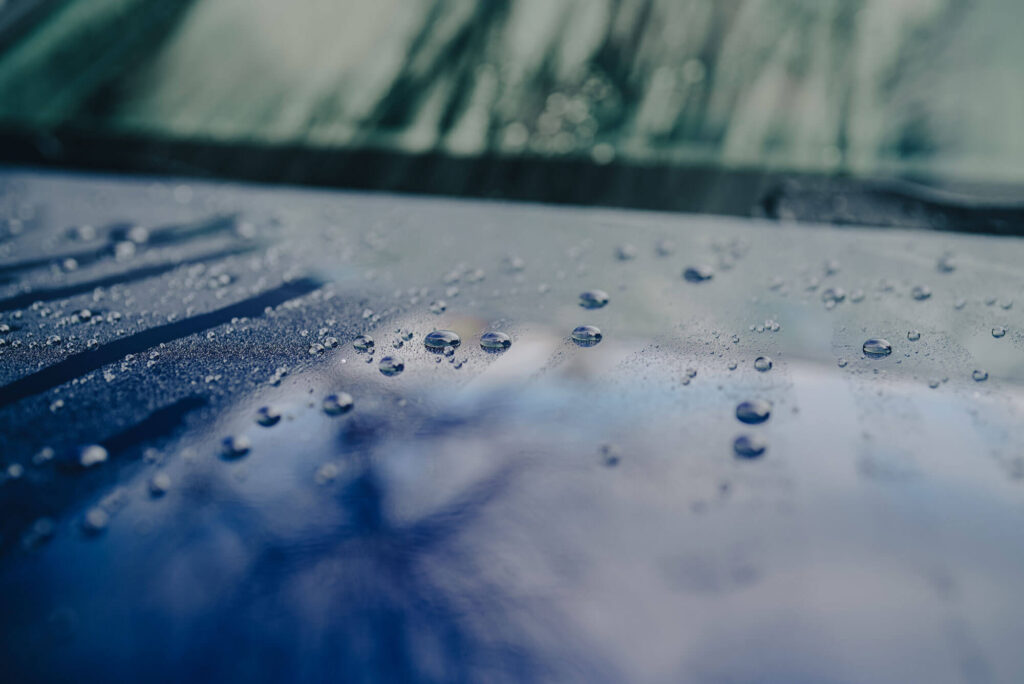
For the functional definition of durability, the most informative measurements are the water contact angle — the angle a droplet forms where it meets the surface, with higher angles meaning stronger beading — and the water sliding angle, the tilt at which a droplet releases and rolls off. Both are measured with a goniometer, an optical instrument that photographs a standardized droplet in profile. A fresh, high-quality ceramic coating typically shows contact angles well above 100 degrees; uncoated automotive clear coat sits far lower. What makes these measurements powerful is not the initial value but the curve: re-measuring contact and sliding angles after each round of imposed wear turns hydrophobicity into a durability instrument. When the angles fall below defined thresholds, the easy-clean effect the customer paid for is gone — regardless of how much coating chemistry technically remains.
Abrasion: Simulating Years of Washing
Mechanical wear — above all, washing — is what actually kills most ceramic coatings in service. Laboratories simulate it with rotating abrasive wheels (Taber testing) or, more realistically for car care, with reciprocating scrub testers: a sponge or pad of controlled material and geometry is loaded with defined pressure and driven back and forth across the coated panel for a counted number of cycles, in the presence of a defined detergent. This family of methods is formalized in standards such as ASTM D2486 and ISO 11998, which exist precisely because scrub results are sensitive to every variable — pad stiffness, load, stroke speed, detergent chemistry — and only standardization makes results comparable between laboratories. Combined with goniometer measurements between scrub intervals, this is the closest a lab can come to fast-forwarding through years of real car washing.
Who Defines These Standards – and Who Doesn’t
The test methods above are written and maintained by standards bodies: ASTM International in the United States, the International Organization for Standardization (ISO) globally, the Japanese Industrial Standards (JIS) committee, and Germany’s DIN, among others. These organizations do essential work — they define, in exact procedural detail, how a test must be run so that a result from one laboratory means the same thing in another.
But here is the point most marketing quietly steps around: no standards body, regulator, or independent authority anywhere defines or certifies what “3 years,” “5 years,” or “10 years” of ceramic coating durability means. ASTM D2486 tells you how to scrub a panel; it does not tell you how many scrubs equal a year. ASTM G154 tells you how to run a UV chamber; it does not tell you how many chamber hours equal a summer. The translation from standardized test output to calendar years is always the manufacturer’s own model — an extrapolation built on assumptions about climate, washing frequency, and use that the buyer usually never sees.
Independent laboratories such as SGS, TÜV, or Intertek can — and for reputable brands, do — verify that a specific test was run correctly and that a coating achieved a specific measured result. That verification is valuable and worth looking for. But even a third-party certificate attests to test performance, not to years. The year figure remains an interpretation. This is not, by itself, a scandal: extrapolation is how all accelerated durability science works, from paint to plastics to pharmaceuticals. It does mean, however, that the credibility of a durability claim rests entirely on whether the manufacturer discloses the model behind it. A published methodology can be examined and challenged; a bare number cannot.
Lab Conditions vs. Your Driveway
How accurate are accelerated results compared to real life? The honest answer from coating science is: directionally reliable, numerically approximate. Accelerated tests are excellent at ranking — a coating that survives 3,000 standardized scrub cycles genuinely is more durable than one that fails at 800, and that ordering almost always holds outdoors. Predicting the exact calendar lifespan of a specific car is a much harder problem, for several structural reasons.
First, laboratory tests isolate stressors that reality combines. A panel in a QUV chamber gets UV without road grit; a panel in a scrub tester gets abrasion without sunlight. On a real car, UV embrittlement, chemical attack, and mechanical wear act simultaneously and amplify each other — a coating weakened by two summers of sun sheds faster under the same wash mitt than a fresh one. Second, acceleration itself distorts: compressing a year of sunlight into weeks of intense UV can trigger degradation chemistry that gentle, prolonged exposure never would, and vice versa. Third, application variables — film thickness, surface preparation, curing conditions — vary far more across thousands of real installations than across a batch of laboratory panels prepared by trained technicians.
None of this makes accelerated testing worthless; it makes the phrase “up to X years” scientifically appropriate rather than evasive — provided the X was actually derived from testing. The practical conclusion for a buyer is not to distrust every number, but to distinguish numbers that emerge from a disclosed, standardized, threshold-based protocol from numbers that appear to have emerged from a marketing meeting.
How to Read a Durability Claim Credibly
Applying everything above, a durability claim deserves confidence when the manufacturer can answer four questions. What was tested? Real automotive paint systems, not bare glass or metal. How was wear applied? A named, standardized mechanical and chemical protocol, ideally harsher than average real-world conditions rather than gentler. What defines failure? Explicit, numeric performance thresholds — not “the coating is still visible.” How were cycles converted to years? A stated equivalence model, calibrated against real-world observation. To make these criteria concrete, the following section describes — as a documented example — how durability ratings are generated at Nasiol’s laboratories.
Inside the Lab: How Nasiol Translates Scrub Cycles into Years
A durability figure is only as credible as the protocol behind it. At Nasiol’s laboratories, ceramic coating lifespan claims are not derived from marketing estimates but from a standardized wear-simulation protocol developed and validated over years of repeated experimentation.
Test preparation: replicating a real car body. Testing begins on metal panels finished with genuine automotive OEM paint — not bare metal or generic substrates — so that the coating bonds to exactly the kind of clear-coat surface it will meet in the field. After application, panels cure at room temperature for 48 hours, matching the full curing window specified for the products themselves.
Baseline measurement: quantifying hydrophobicity. Before any wear is applied, each panel’s water repellency is characterized with a precision goniometer. Two parameters are recorded: the water contact angle and the water sliding angle. Each measurement is repeated ten times at different points across the panel, and both the mean and median values are calculated and logged. This repetition matters: contact angle readings vary point-to-point on any real painted surface, and a single measurement can flatter or understate a coating’s true performance.
The scrub test: harsher than the industry norm. Wear is then simulated on an automated scrub tester — a standardized sponge of controlled type, density, and size, pressed against the panel at a fixed load and cycled mechanically. The methodology belongs to the same family of reciprocating scrub-resistance tests formalized in ASTM D2486 and ISO 11998, adapted to automotive clear-coat conditions. One deliberate difference sets the protocol apart: the scrub medium is a pH 10 alkaline car shampoo, not the pH-neutral formulas commonly used in industry testing. The reasoning is grounded in field reality — most commercial car washes do not use pH-neutral chemistry. Testing with a milder detergent produces friendlier numbers; testing at pH 10 produces numbers closer to what a coating actually endures.
From cycles to years: the calibration. After every 1,000 scrub cycles, contact and sliding angles are re-measured under the identical ten-point procedure. The conversion at the heart of the durability rating is this: 1,000 scrub cycles ≈ one year of average real-world washing and use. This equivalence was not assumed — the sponge specification, applied pressure, shampoo chemistry, and paint substrate were all calibrated against real-life vehicle aging data, a validation process that itself took years to confirm. A coating “survives” a checkpoint only if it still meets two thresholds:
- Water contact angle above 96° — the surface still actively beads water
- Water sliding angle below 15° — droplets still release easily, carrying dirt with them
What the numbers show. Under this protocol, Nasiol ZR53 Ultimate Car Nano Ceramic Coating, maintained contact angles above the 98° threshold beyond 3,000 scrub cycles — the equivalent of more than three years of simulated washing — without any booster or top-up product applied. That result aligns directly with the product’s published rating of up to 3 years of protection with minimal maintenance, and the same protocol underpins the ratings across the range, including the 5-year classification of Nasiol NL272. The durability number on the label, in other words, is the output of the test — not a target the test was designed to confirm.
A Note on Variability
Like any accelerated protocol, these year-equivalence figures describe performance under controlled, averaged conditions — real-world results will vary around them. Car manufacturers use different sheet metals, primers, and clear-coat chemistries, and since a ceramic coating bonds to the outermost paint layer, these differences can shift adhesion and wear behavior slightly. Climate adds further spread: extreme heat or cold, intense UV, salt air, dust, and road debris consume a coating’s service life at different rates in different regions. Washing habits matter too — brush washes and harsh chemicals accelerate hydrophobic decay, while proper hand washing and periodic maintenance extend it.
The same coating may therefore perform above its rated duration on one vehicle and slightly below it on another. A credible durability claim is a tested benchmark under defined conditions, not a warranty of identical performance everywhere — and manufacturers who publish their test logic make that distinction transparent.
What This Means Across a Product Range
Threshold-based testing also explains why a single manufacturer can honestly offer coatings with different ratings. Within the Nasiol ceramic range, Nasiol ZR53 — a single-layer consumer-applicable coating — carries an up-to-3-year rating, while Nasiol NL272, a denser professional-grade formulation, carries an up-to-5-year (durable up to 7.000 scrubs in lab tests) rating: the difference reflects how many scrub-and-measure checkpoints each chemistry survives above the same contact-angle and sliding-angle thresholds, under the same protocol. When ratings within a range are generated by one consistent method, the numbers become comparable with each other in a way that numbers from different brands, tested by undisclosed methods, never are.
Buy the Manufacturer, Not the Label
When choosing a nano ceramic coating for your vehicle, the label is the least reliable evidence available. Advertised year figures, polished packaging, and enthusiastic forum threads or social media reviews — some of which are commissioned rather than earned — are all easy to produce. What is not easy to produce is the infrastructure behind a valid claim: a materials laboratory, standardized test equipment, documented protocols, and years of calibration data. Claiming 5 or 10 years of durability takes a sentence; making that number real and verifiable takes expertise. So look past the wording and evaluate the manufacturer itself — does it develop its own chemistry, publish its testing logic, and stand behind its ratings with method rather than adjectives? A company that can show how it knows is worth more than any number on a bottle.
Beyond Automotive: The Same Question Everywhere Coatings Are Sold
The durability question examined here is not unique to car care. Marine gelcoat protection, aircraft exterior treatments, architectural glass coatings, and protective treatments for roofing and building façades all advertise service lives measured in years, and all face the same structural issue: standards bodies define test methods, while the translation into calendar time remains each manufacturer’s model. The disciplines differ only in which stressors dominate — salt immersion at sea, extreme UV and thermal cycling at altitude, freeze-thaw cycles on rooftops — but the buyer’s test is identical in every industry: ask for the method behind the number. Surface treatment suppliers who work across these sectors, as nanocoating manufacturers typically do, have particular reason to keep their durability methodology consistent and documented, because their claims are scrutinized by industrial procurement teams as well as consumers.
Frequently Asked Questions
It means the manufacturer predicts the coating will keep delivering its functional properties — primarily water beading and easy cleaning — for that period under average conditions. The figure is an extrapolation from accelerated laboratory testing, not a guarantee, and there is no external authority that certifies year ratings. Its reliability depends entirely on the test protocol behind it.
No one certifies the year figure itself. Standards bodies such as ASTM International and ISO define test methods (for example, ASTM D2486 for scrub resistance or ASTM G154 for accelerated UV weathering), and independent laboratories can verify that a coating passed a specific test. But converting test results into years is always the manufacturer’s own calibration, non of OEM’s can perform that, which is why transparent methodology matters more than any logo on the label.
The main families are pencil hardness (ASTM D3363), accelerated UV weathering (ASTM G154, ISO 4892), chemical and salt-spray resistance (ASTM B117), water contact angle and sliding angle measurement by goniometer, and mechanical scrub or abrasion testing (ASTM D2486, ISO 11998). Functional durability is best captured by measuring how contact and sliding angles decay across repeated scrub cycles.
They are reliable for ranking coatings against each other and approximate for predicting exact lifespans. Real vehicles combine UV, chemicals, and abrasion simultaneously, while lab tests usually isolate one stressor at a time, and climate, paint systems, and washing habits vary widely. This is why honest ratings are phrased as “up to” a number of years.
The water contact angle is the angle a droplet forms against a surface — the higher the angle, the stronger the beading. In Nasiol’s durability protocol, a coating is considered functionally alive only while its contact angle stays above 96° and its sliding angle stays below 15°; below those thresholds, the easy-clean effect is effectively lost even if some coating remains.
Not directly. Pencil hardness (ASTM D3363) describes a fresh film’s resistance to light marring, measured once. Durability describes how long the coating’s performance survives ongoing UV, chemical, and mechanical stress. A coating can be very hard and still lose its hydrophobic function quickly, so hardness and lifespan should be read as separate specifications.
Significantly. Mechanical washing is the largest single wear factor for ceramic coatings, which is why laboratory scrub cycles are used as the year-equivalence basis in the first place. Automated brush washes, contaminated mitts, and harsh chemicals shorten real-world lifespan, while proper hand washing and periodic maintenance can extend a coating beyond its rated duration.
About Nasiol
With nearly 20 years of industry experience, Artekya Technology is an R&D company that has made quality and technology its core competencies. It produces nano-coating products for many surfaces, such as metal, glass, ceramics, wood, and textiles.Thanks to its industry experience, NASIOL products, the main brand of Artekya Technology, are offered worldwide through offices in the Czech Republic and the USA, as well as the R&D and Production Center, Head Office in Turkey. Products with unique nano-technological formulations developed under the brand name NASIOL are used in the automotive, industrial, maritime, and textile sectors, as well as in household and personal goods.. Every NASIOL product is crafted with precision, rigorously tested, and manufactured to exceed the highest industry standards, leveraging advanced R&D techniques. At Artekya, we prioritize being a trusted source for nano-coating solutions. Our approach is rooted in adapting to market needs and advancing sustainability, continuously enhancing our product portfolio to meet the demands of tomorrow. The company develops and manufactures nano coating solutions for automotive, marine, aviation, textile, construction, and industrial applications, exporting to distributors and professional users worldwide. Product durability ratings across the Nasiol range are established in the company’s own laboratories through standardized wear-simulation and surface-analysis protocols — including goniometric contact-angle tracking and calibrated scrub testing — developed over years of materials research.