There is a complaint that appears with remarkable consistency in detailing forums, installer support inboxes, and vehicle owner communities:
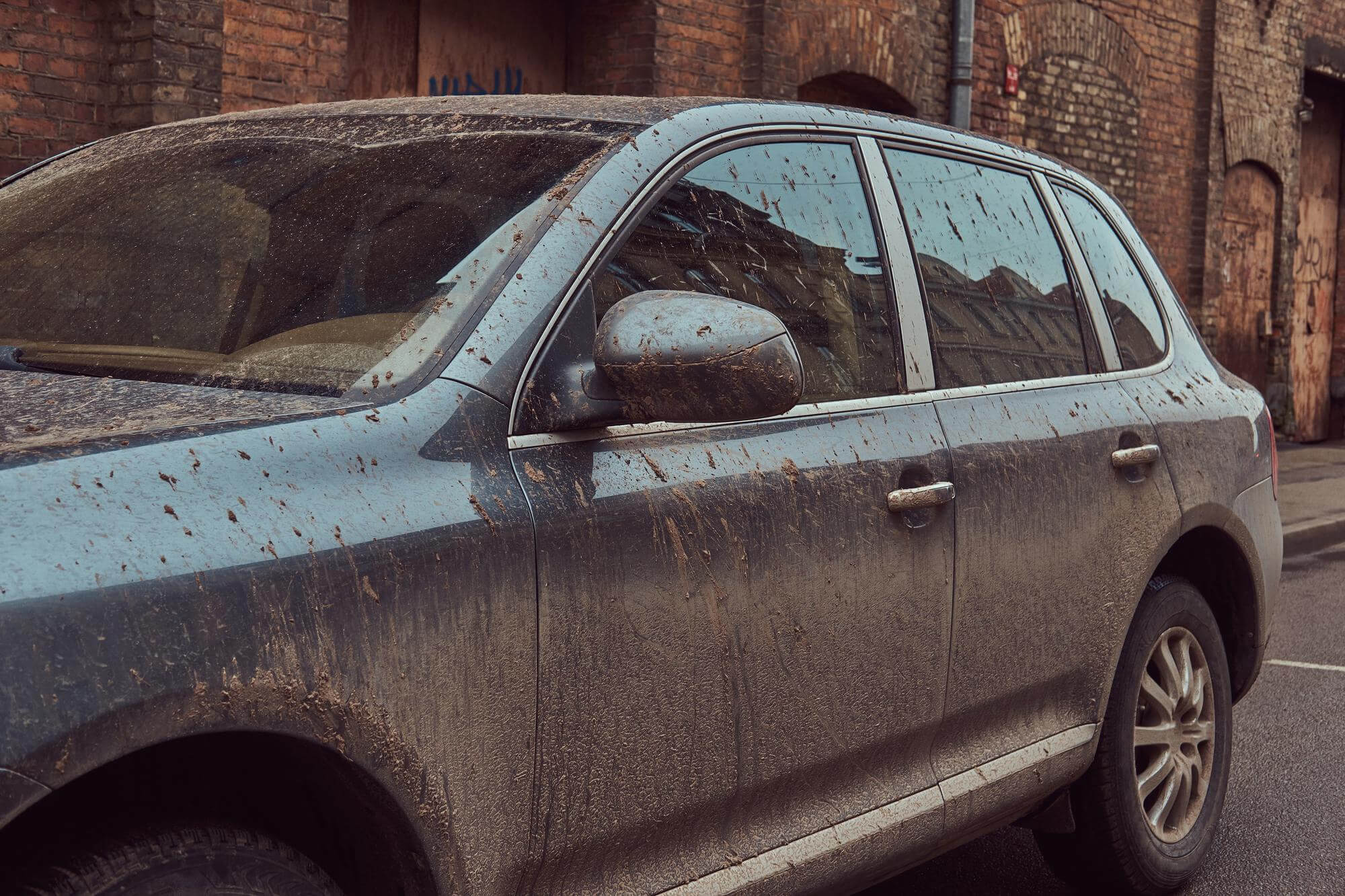
I paid thousands for paint protection film, and now my car seems to get dirtier – faster – than it ever did before.
At first glance, this appears contradictory. Paint protection film (PPF) is one of the most effective physical defenses available for automotive paintwork. A properly installed polyurethane film absorbs stone chips, resists abrasion, and — in self-healing formulations — even claims repairs its own minor scratches under heat. Owners who invest thousands of dollars in full-body PPF coverage are, by definition, people who care deeply about their vehicle’s appearance.
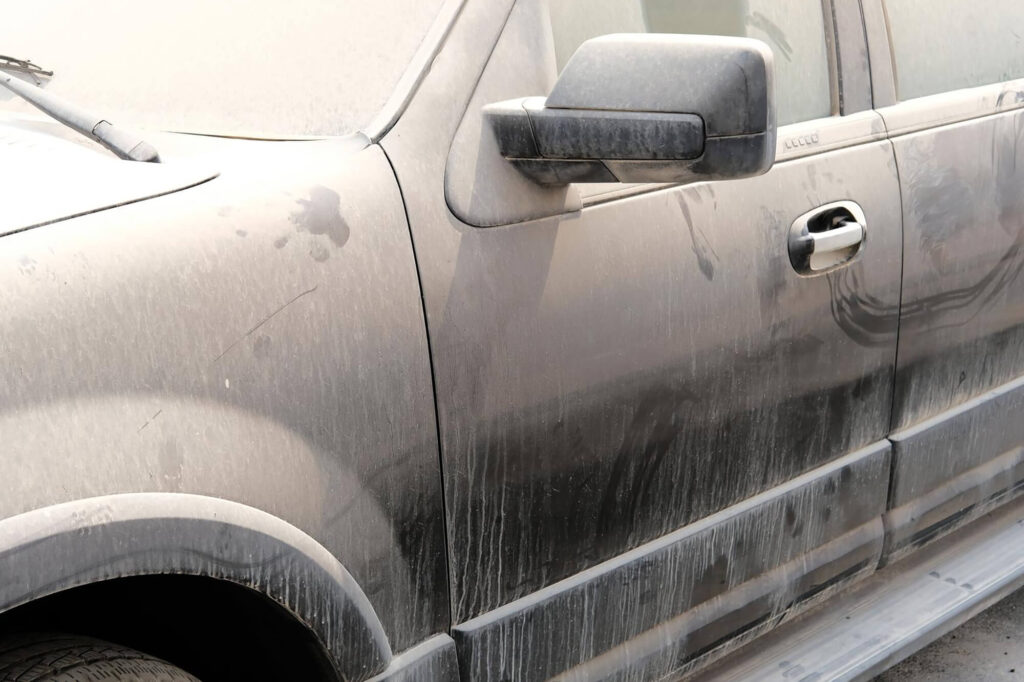
And yet the observation is not imaginary. It is a real, repeatable, and physically explainable phenomenon. A film-wrapped vehicle can attract, hold, and display dirt differently — and often more visibly — than a bare, polished clear coat. The reasons are found not in the quality of the film, but in the fundamental surface science of thermoplastic polyurethane: its surface energy, its electrostatic behavior, its microscopic texture, and the way its edges interact with water, soap, and road contamination.
This article examines why PPF-wrapped vehicles can appear dirtier and not shiny than unwrapped ones, what is actually happening at the material level, what the long-term consequences are if the causes are left unaddressed, and how a correctly formulated nano ceramic top coating — combined with disciplined wash practice — resolves the problem at its source.
The Problem: A Protective Layer That Seems to Collect Dirt
The paradox, stated precisely
Paint protection film and automotive clear coat are two very different materials asked to do the same visual job. Clear coat is a hard, highly crosslinked, factory-cured resin — typically a polyurethane or acrylic-urethane system — that has been machine-polished to an extremely smooth, low-texture finish. PPF, by contrast, is a flexible thermoplastic polyurethane (TPU) sheet, usually 150–200 microns thick, laminated with an adhesive layer below and, in most modern films, a soft self-healing top layer above or sometimes PVC based polymer.
That flexibility is the film’s entire purpose. It is what allows PPF to absorb impact energy from road debris rather than transmitting it into the paint. But flexibility, softness, and polymer chemistry come with surface characteristics that behave differently from cured, polished clear coat — and several of those characteristics work against the film staying visually clean.
Three distinct problems are most commonly reported by owners of film-wrapped vehicles:
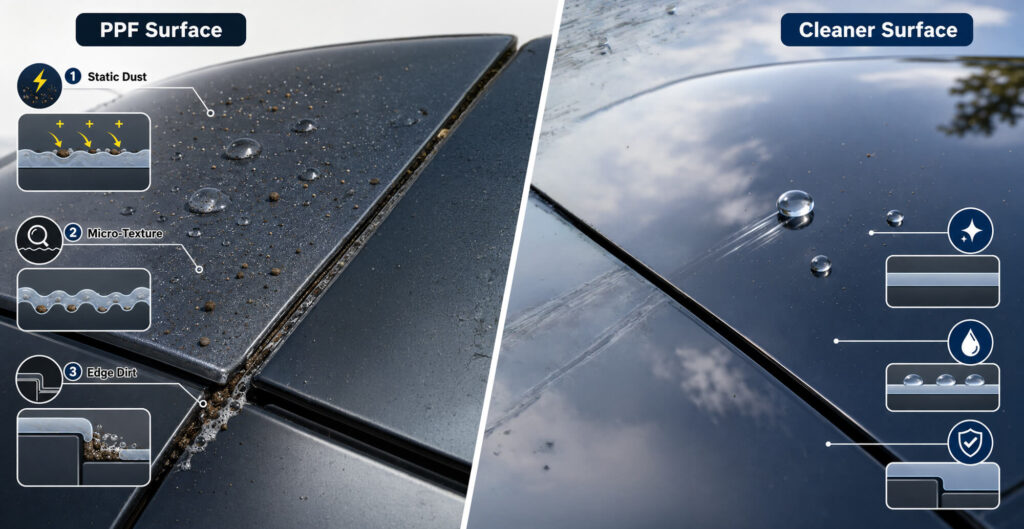
Edge dirt lines. Thin, dark lines of accumulated wax residue, dried soap, and road grime that trace the perimeter of each film panel. They appear along wrapped edges, around sensor cutouts, and at panel seams — and once established, ordinary washing does not remove them.
Rapid dust re-accumulation. A freshly washed, film-wrapped car that visibly collects fine airborne dust within hours, sometimes seeming to pull dust toward itself, while an unwrapped vehicle parked beside it stays cleaner for longer.
Post-wash filming and streaking. A hazy, dirt-trapping residue that develops shortly after washing, particularly when tire dressings, silicone-based detail sprays, or oily “quick shine” products have been used anywhere on the vehicle.
The Mechanism: What Is Actually Happening on the Film Surface
2.1 Surface energy: why contamination adheres to PPF
Every solid surface has a measurable property called “surface free energy” — the excess energy of molecules at the surface compared to those in the bulk of the material. Surface energy governs adhesion: how readily water spreads, how strongly oils bond, and how tenaciously dust particulate contamination sticks.
Freshly installed PPF often exhibits reasonable water-repellent behavior, because many premium films ship with a factory hydrophobic top layer. The critical detail is that this factory hydrophobicity is not permanent. Under real-world exposure — ultraviolet radiation, traffic film, alkaline wash chemistry, and mechanical wiping — the film’s outermost layer gradually oxidizes and wears in a few months period. As it does, polar functional groups form on the surface, surface energy rises, and the water contact angle falls. In practical terms, the film transitions from water-shedding to water-holding.
A higher-energy surface does two unwelcome things simultaneously. It allows water to sheet and cling rather than bead and release, which means mineral-laden droplets dry in place as water spots. And it increases the adhesion of oily road film, exhaust particulates, and organic contamination, all of which bond more strongly to a polar, oxidized polymer surface than to a low-energy one.
2.2 Electrostatic attraction: the polymer film as a dust magnet
Thermoplastic polyurethane is an electrical insulator. When an insulating polymer surface experiences friction — wind shear during driving, the drag of a drying towel, even the flow of rinse water — it undergoes triboelectric charging: electrons transfer between the surfaces in contact, leaving the film carrying a static charge that it cannot dissipate.
Automotive clear coat over a metal body panel behaves differently. Although clear coat is also an insulator, it is thin, hard, and sits directly above a conductive metal substrate that provides a pathway for charge to bleed away. A 150–200 micron polymer PPF film, bonded through an adhesive layer, is both a thicker dielectric and a more efficient charge generator, particularly when new or when its surface has been rubbed dry with microfiber in low-humidity conditions.
A statically charged panel attracts fine airborne dust and dirt particulate — pollen, brake dust, soot, mineral dust — through simple electrostatic force. The particles most strongly affected are precisely the smallest ones: light enough to be suspended in air and to respond to a weak electric field. This is why the effect presents as a fine, even veil of dust that reappears within hours of washing, rather than as coarse dirt.
2.3 Micro-texture and porosity: where dirt finds a mechanical grip
At the microscopic scale, a machine-polished clear coat is one of the smoothest surfaces most people will ever own. A thermoplastic film top layer — especially a soft, self-healing one — is not. Its surface exhibits micro-texture from manufacturing, and that texture increases over time as the elastomeric top layer accumulates micro-marring, swirl marks from washing, and localized wear.
Surface roughness matters for cleanliness in two ways. First, it increases real surface area, giving contamination more sites to bond to. Second, micro-valleys act as mechanical anchoring points: particulate settles into recesses where wash media cannot easily reach, and oily films wick along texture by capillary action. A film surface that has lost its factory top layer smoothness therefore holds dirt both chemically (through raised surface energy) and mechanically (through texture) — a combination that polished clear coat largely avoids. So it looks dirtier.
2.4 The edge problem: capillary channels at every seam
PPF is installed in panels, and every panel has a perimeter. Even in an expert wrapped-edge installation, there are locations where the film terminates on the visible surface: around emblems, sensors, panel gaps, and complex curvature. At each termination, a step of 150–200 microns exists between the film surface and the paint below.
That step is small to the eye and enormous at the scale of fluid physics. It forms a capillary channel. During washing, soap solution, dissolved wax, suspended grime, and dressing overspray are drawn along the edge by capillary action. During drying, water retreats from the open panel but remains held in the channel, where it evaporates slowly and deposits everything it carried — surfactant residue, carrier oils, mineral content, and particulate — precisely along the seam.
Repeated over dozens of wash cycles, these deposits laminate into the familiar thin black line. The deposits are protected from wash media by their position: a mitt glides over the step, cleaning the flat surfaces on either side while leaving the channel contents untouched. Worse, many of the deposited materials — waxes and silicone carriers in particular — are tacky binders that actively capture new dirt, so the line darkens and widens with time.
2.5 Chemical residue: how the wrong products convert a clean film into a dirt trap
The final mechanism is self-inflicted, and it is arguably the most common. Many popular tire dressings, trim restorers, and spray-on gloss enhancers are built on silicone oils (commonly polydimethylsiloxane in oil-heavy carriers) or mineral-oil bases. These products are designed to leave a film — that residual film is the shine they produce.
On rubber and textured plastic trim, an oily film is acceptable. On a polyurethane paint protection film, it is a liability. Overspray from tire dressing applied to a mounted wheel travels onto the lower body panels. Oily quick-detailer residue spreads across the film during wipe-down. In both cases, the result is a thin, non-drying, tacky layer across the film surface — a layer with high dust affinity and genuine adhesive character.
An oiled film surface can capture and hold airborne dust within hours of a full wash. The owner concludes that the film “gets dirty fast,” when the accurate diagnosis is that the film has been coated in an unintentional adhesive. Because TPU is more chemically receptive to oil absorption at its surface than dense cured clear coat, the residue also persists longer on film and resists removal by shampoo alone, typically requiring a dedicated silicone-free cleaner to strip fully.
The Consequence: What Happens When the Causes Go Unaddressed
From cosmetic annoyance to accelerated film aging
The immediate consequence of these mechanisms is visual: a vehicle that never quite looks clean, edge lines that photograph badly, and an owner who begins to doubt the value of the film investment. But the longer-term consequences are material, not merely cosmetic.
Contamination accelerates film degradation. Traffic film and organic fallout held against the film surface are not chemically inert. Acidic contamination — bird droppings, insect residue, industrial fallout, acid rain deposits — etches and stains the polyurethane top layer during extended contact. Embedded contamination also increases UV absorption at the surface, and ultraviolet exposure is the primary driver of the yellowing and clouding that end a film’s visual service life. A film that stays dirty ages faster than a film that stays clean; the relationship is direct.
Aggressive cleaning causes secondary damage. Owners confronting stubborn edge lines and persistent films tend to escalate: stronger chemicals, stiffer brushes, more pressure. Each escalation carries risk on a soft polymer surface. Solvent-heavy cleaners can attack the film’s top layer and, at the edges, wick beneath the film to compromise the adhesive. Mechanical scrubbing inflicts micro-marring that raises surface texture — which, as described above, makes the film hold dirt more effectively, inviting the next round of aggressive cleaning. The cycle is self-reinforcing.
Hydrophobicity loss compounds every other mechanism. Once the factory water-repellent layer is exhausted — again, commonly within roughly few to six months — every wash takes longer, every rain leaves spots, and every contaminant bonds more strongly. The film continues to perform its impact-protection function perfectly. Its maintenance performance, however, has quietly collapsed, and the gap between “protected” and “presentable” widens with each month. Result is dirtier and dull looking car body.
The Mitigation: Restoring Low-Energy, Low-Static, Easy-Clean Behavior
The mechanisms above share a common thread: they all originate at the outermost molecular layer of the film. That is precisely where intervention is easiest, least invasive, and most effective.
Apply a dedicated nano ceramic coating formulated for film
The single most effective intervention is to replace the film’s exhausted factory top layer with an engineered one: a nano ceramic coating specifically formulated for flexible film substrates.
This qualifier — specifically formulated for film — is not marketing language; it is a materials requirement. Conventional ceramic coatings developed for rigid clear coat cure into a comparatively hard, inflexible layer. Applied to a soft, elastic TPU or PVC film, a rigid coating can crack under the film’s normal flexing and, critically, can interfere with the self-healing behavior that depends on the top layer’s ability to flow and re-level under heat. A film-specific coating must remain flexible after curing and must be chemically compatible with polyurethane, PVC, and vinyl surfaces.
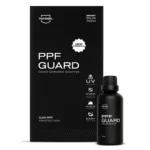
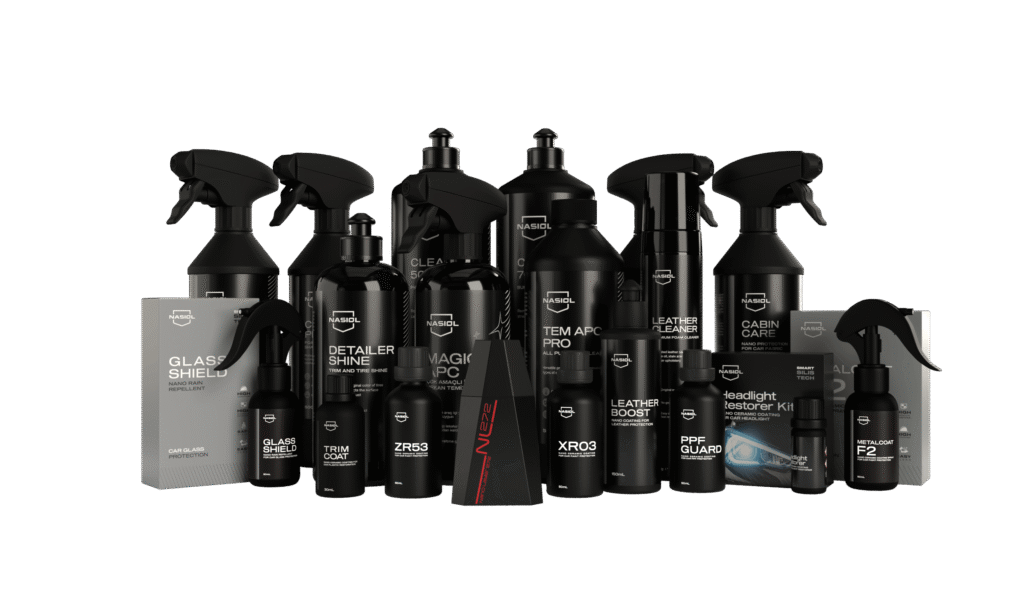
Nasiol PPFGuard is engineered to this specification. It is a flexible nano ceramic coating based on nano-scale silicon dioxide chemistry, developed for application over paint protection films — matte and transparent polyurethane (PU), high-quality PVC films, and vinyl wraps — and formulated to preserve the film’s own physical properties, including the self-healing behavior of self-healing films and the visual character of glossy, matte, and satin finishes. In its current New Formula, it provides protection for up to two years per application.
It restores low surface energy. The cured coating presents a dense, low-energy outer layer that returns the film to strongly hydrophobic behavior — water beads at a high contact angle and releases, carrying loose contamination with it. Oily road film and organic fallout bond weakly to the low-energy surface and release under gentle washing. Nasiol’s documentation for PPFGuard notes that even as film loses its own hydrophobicity after roughly few months, the coating restores and extends water-repellent performance for up to two years.
It smooths the microscopic texture. The nano-scale coating fills and levels the film’s micro-valleys, reducing the real surface area available for bonding and eliminating the mechanical anchor points where particulate and oils lodge. The practical result is the “easy-to-clean” behavior the coating category is named for: contamination that does adhere sits on the surface rather than in it, and releases with pH-neutral shampoo and light contact.
It reduces the electrostatic dust effect. By sealing the raw polymer surface and reducing the friction coefficient of wiping and airflow across it, the coated surface generates and holds less triboelectric charge, and its low-energy character gives settled dust little to bond to. The fine dust veil that reappears within hours on an uncoated film takes markedly longer to establish, and removes with far less effort.
It defends against UV-driven yellowing. The coating contributes UV and chemical resistance at the outermost layer — the layer where photooxidation begins — helping prevent the color fading and yellowing that degrade film clarity over time.
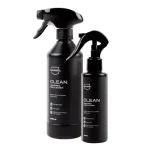
Application is straightforward process: the film surface is washed, decontaminated, and — where appropriate — corrected with silicone-free products, then cleaned to a residue-free state with a dedicated surface preparation cleaner such as Nasiol Clean. The coating is applied in single layer, worked in sections of about one square meter, with excess buffed within 30–60 seconds and approximately one hour between coats. Best results are achieved near 23°C and 50% relative humidity, with the coated vehicle kept away from water, dust, and direct sunlight during initial curing and away from detergent washing for the first 24 hours.
Who Is Nasiol: The Manufacturer Behind the Coating
From university research group to global nano coating manufacturer
Nasiol is the registered trademark of Artekya Technology, the pioneering manufacturer of protective nano coating materials in Türkiye and Europe.
Today, with nearly two decades of industry experience, Artekya designs, formulates, and manufactures its full product range in-house at its R&D and production center in Türkiye, with offices in the Czech Republic and the USA serving global distribution. Nasiol formulations protect surfaces across the automotive, industrial, marine, and textile sectors — metal, glass, ceramic, wood, fabric, and polymer substrates alike — under a proprietary silicon dioxide platform and siloxane technology the company calls Smart Silis Tech, engineered for high performance with economical raw material consumption and reduced environmental impact.
This matters for the subject of this article for a simple reason: Nasiol PPFGuard is not a rebranded generic formulation. It is a substrate-specific product from a manufacturer that controls its own chemistry from research bench to production line — which is what makes a flexible, film-compatible ceramic coating possible in the first place.
Why a nano coating is not a wax – the difference is chemistry, not marketing
The word “coating” is used loosely in car care, and the loose usage obscures a fundamental distinction. Waxes, oils, and polymer spray sealants are sacrificial deposits. A carnauba wax or silicone-oil detailer sits on top of the surface as a soft, physically adsorbed layer, held by weak intermolecular forces. It produces gloss and short-lived water behavior, but it does not bond to the substrate. It softens in heat, dissolves in detergent, abrades under wiping, and disappears within weeks — and, as Part Two of this article showed, its oily residue actively attracts and binds dust while it lasts.
A nano ceramic coating operates on entirely different chemistry. Nano-scale silicon dioxide compounds in a reactive carrier wet into the microscopic texture of the surface and then cure — crosslinking into a continuous, chemically bonded network that becomes, functionally, the new outermost layer of the substrate.
The practical consequences follow directly. A wax must be reapplied monthly and turns dusty as it degrades; a cured nano coating maintains hydrophobic, easy-to-clean behavior through hundreds of wash cycles. A wax fills texture temporarily; a nano coating levels it durably. A wax adds an oily layer with dust affinity; a nano coating adds a slick, inert one with almost none. These are not differences of degree between competing shine products — they are different categories of surface technology.
Why coating the PPF is as essential as coating the paint
Ceramic coating bare paintwork is now standard practice among owners who care about long-term appearance, and the reasoning is universally accepted: clear coat is the vehicle’s outermost sacrificial layer, so protecting it preserves everything beneath. The logic does not stop applying when a film is installed — it transfers to the film, because the film has become the outermost layer.
If anything, the case is stronger for PPF than for paint. Polyurethane film is softer than cured clear coat, more textured at the microscopic scale, more prone to electrostatic dust attraction, and more chemically receptive to oil absorption and UV-driven yellowing. Its factory hydrophobic layer is exhausted within roughly six months, after which every mechanism described in Part Two operates unopposed. An uncoated film keeps protecting the paint mechanically while its own surface degrades visually — and since the film’s visual clarity is the only thing standing between the paint and the observer, a degraded film defeats the aesthetic purpose of the entire investment.
A film-specific coating such as PPFGuard completes the protection stack: the paint is protected by the film, and the film is protected by the coating. Treating this final layer as optional is the equivalent of leaving fresh paintwork bare — technically possible, but inconsistent with the reasoning that justified the film in the first place. For a surface investment routinely costing thousands, a flexible ceramic top coat is not an accessory; it is the maintenance layer the system was missing.
Conclusion: The Film Protects the Paint – the Coating Protects the Film
The paradox that opened this article dissolves once the surface science is understood. Paint protection film is an impact-protection technology, not a cleanliness technology. Its polymer surface — flexible, insulating, and progressively higher in surface energy as its factory top layer wears — attracts and holds contamination in ways that polished clear coat does not. Its edges create capillary channels that concentrate grime into visible lines. And common detailing products, misapplied, convert its surface into a dust-binding film.
Every one of these mechanisms operates at the outermost molecular layer, and every one of them is addressable there. A flexible, film-specific nano ceramic coating such as Nasiol PPFGuard restores low surface energy, smooths microscopic texture, suppresses electrostatic dust attraction, and shields the film against the UV exposure that drives yellowing — without compromising the self-healing and finish characteristics that justified the film investment in the first place. Combined with deliberate edge cleaning and the elimination of silicone-heavy products, the result is a wrapped vehicle that is protected and presentable: the film defending the paint, and the coating defending the film.
Related reading: [Understanding Hydrophobic Surface Technology: Contact Angle, Surface Energy, and Real-World Performance] | [Ceramic Coating Chemistry: How Nano-Scale Silicon Dioxide Bonds to Automotive Surfaces]
Frequently Asked Questions
Why does my car with paint protection film get dirty faster than it did before the film was installed?
Because the film’s surface behaves differently from polished clear coat. Thermoplastic polyurethane film holds electrostatic charge that attracts fine airborne dust, develops higher surface energy as its factory hydrophobic layer wears (typically within about six months), and has a softer, more textured surface that gives contamination both chemical and mechanical grip. Film edges additionally act as capillary channels that collect wax, soap, and grime into visible dark lines. None of this indicates a defective installation — it is the normal surface physics of polymer films, and it is correctable with a film-specific nano ceramic coating and adjusted wash practice.
What causes the black dirt lines along the edges of PPF panels?
Each film edge creates a small step between the film surface and the paint, and that step functions as a capillary channel. During washing and drying, soap solution, dissolved wax, dressing residue, and suspended grime are drawn into the channel and deposited there as the water evaporates. Standard wash mitts glide over the step without cleaning inside it, so deposits accumulate wash after wash into a laminated dark line. Prevention requires cleaning edges deliberately with a soft detail brush during every wash and keeping wax and oily products away from film perimeters.
Does static electricity really make PPF attract dust?
Yes. Polyurethane film is an electrical insulator, and friction from airflow, towel drying, and washing generates triboelectric charge on its surface. Unlike thin clear coat over a conductive metal panel, a thick polymer film dissipates this charge poorly, so the surface remains charged and attracts fine airborne particles — pollen, brake dust, and soot — through electrostatic force. The effect is strongest in dry conditions and on freshly wiped film. A nano ceramic coating reduces the effect by sealing the polymer surface, lowering wiping friction, and giving settled dust a low-energy surface it cannot bond to.
Can I apply a regular ceramic coating on top of paint protection film?
It is not recommended. Conventional ceramic coatings developed for rigid, cured clear coat form a comparatively hard layer that can crack as the flexible film moves, and can interfere with the heat-activated self-healing behavior of premium films. A coating intended for film must remain flexible after curing and be formulated for polyurethane, PVC, and vinyl chemistry. Nasiol PPFGuard is developed specifically for this purpose: it bonds to flexible film surfaces, preserves self-healing properties, and maintains the appearance of glossy, matte, and satin finishes.
How does Nasiol PPFGuard keep a film-wrapped car cleaner?
PPFGuard cures into a low-surface-energy nano ceramic layer based on nano-scale silicon dioxide. This layer restores strong hydrophobic behavior — water beads and releases rather than clinging and spotting — fills the film’s microscopic texture so contamination has fewer anchoring points, weakens the adhesion of oily road film and organic fallout, and adds UV and chemical resistance that helps prevent yellowing. The result is an easy-to-clean surface on which dirt accumulates more slowly and releases with gentle, pH-neutral washing. The current formulation provides protection for up to two years per application.
Which surfaces can PPFGuard be applied to, and which should be avoided?
PPFGuard is formulated for paint protection films and wraps: matte and transparent polyurethane (PU) film, high-quality PVC film, and vinyl. It should not be applied to low-quality films, films with bubbles or lifted edges, absorbent surfaces, temporary road films, interior window tints, or any film that lacks solvent resistance. Surface preparation matters: the film must be washed, fully decontaminated with a silicone-free process, and dried before the two-coat application.
What is the correct way to wash a PPF-wrapped car to avoid the dirt problems described here?
Use a pH-neutral automotive shampoo without gloss additives, wash with a soft mitt using straight-line motions and minimal pressure, and clean film edges with a soft detail brush as a dedicated step. Apply tire dressings with a pad rather than a spray to prevent silicone overspray reaching the film, and keep oil-based quick detailers off wrapped panels entirely. Dry by blotting, particularly along edges, rather than dragging. On a film treated with a nano ceramic coating, avoid detergent washing for the first 48 hours after application; thereafter, this routine maintains both the coating and the film with minimal effort.