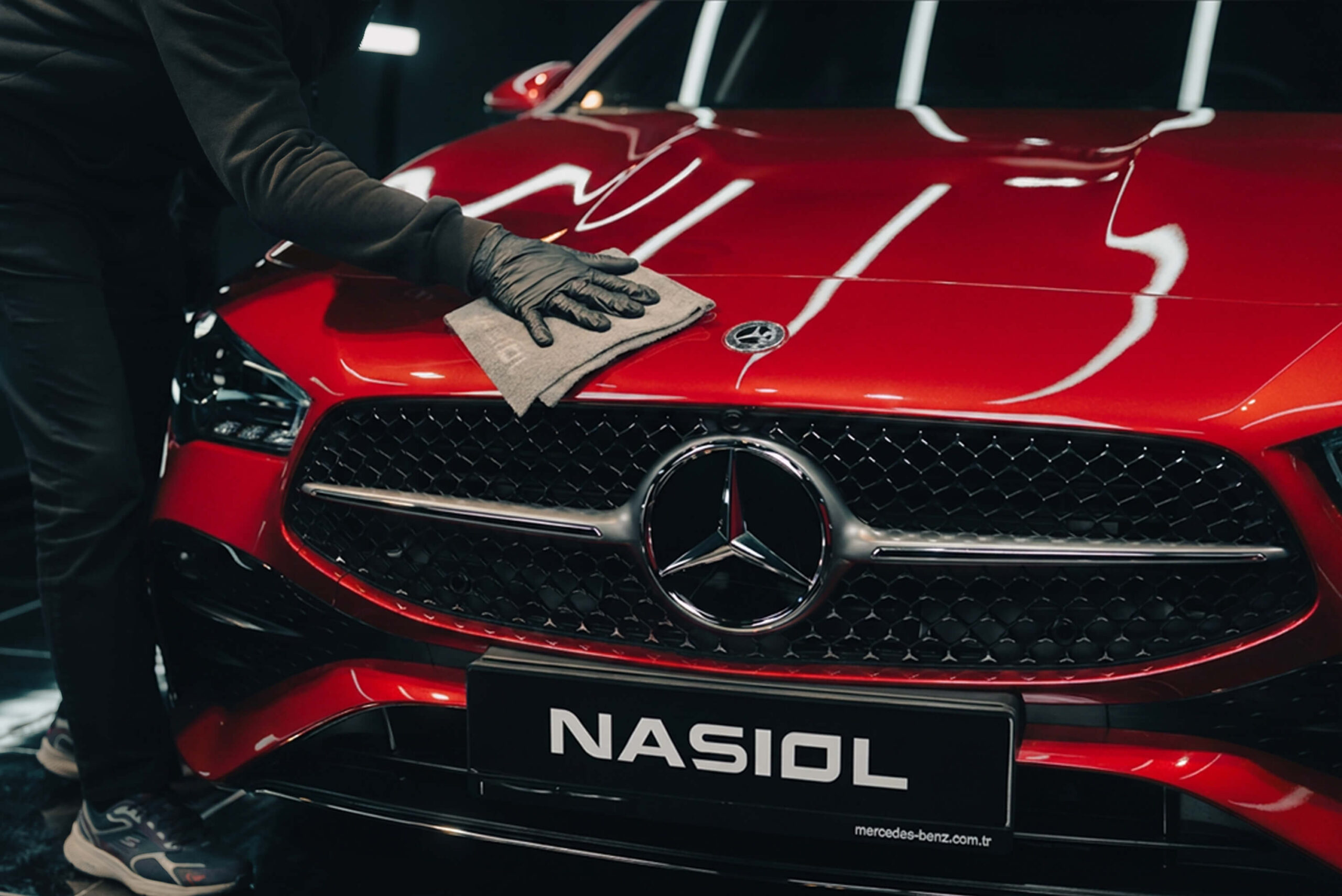
You did everything right. Paid for a proper ceramic coating, watched the water bead up and roll off the hood on day one, felt like the car was finally taken care of for good. Then a few weeks later you walk out to the driveway and there they are, pale, ring-shaped marks scattered across the roof and trunk, sitting right on top of the coating you paid for.
If you’ve typed “why does ceramic coating still get water spots” into Google, you’re one of a lot of people asking that same thing. It’s probably the most common complaint detailers hear about paint protection, and honestly, one of the least understood parts of it. Ceramic coating was never built to stop water spots outright, it just tilts the odds in your favor. Once you know why the spots actually form, preventing and removing them gets a lot less mysterious.
Why Does Ceramic Coating Still Get Water Spots?
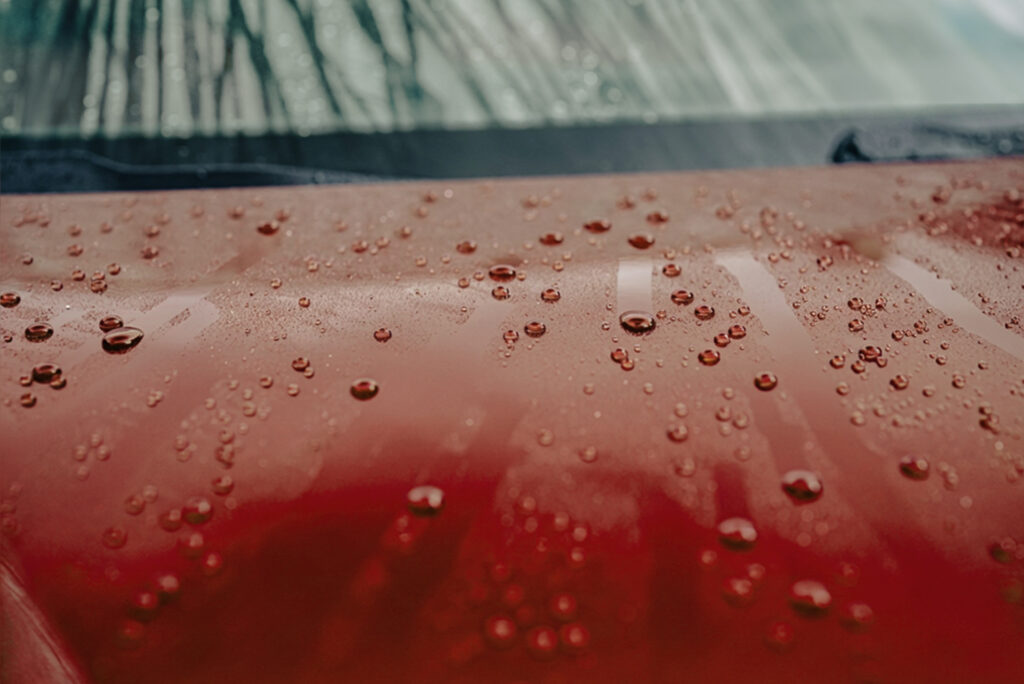
Here’s the misconception that trips most people up: a ceramic coating forms a thin, hard, glass-like layer (usually SiO2-based) that bonds to your clear coat and raises the surface tension of the paint. That’s what makes water bead up into tight little droplets and roll off instead of sheeting across the panel. It’s hydrophobicity, and it’s a real benefit, less water sitting on the paint for less time means fewer chances for a spot to form.
But “hydrophobic” doesn’t mean “immune to minerals.” Water on its own doesn’t stain anything. What leaves a mark is whatever’s dissolved in it, calcium, magnesium, silica, whatever your tap, hose, sprinkler, or even the rain happened to pick up on the way down. When a droplet evaporates, on coated paint or bare paint, the water disappears but the minerals don’t. They stay put as a dried residue, and that’s the ring you’re looking at. A coating shortens how long the droplet sticks around and how much surface it touches, but if it’s left to dry in the sun, the minerals inside it still land somewhere. Usually right on top of your coating.
There’s also a slightly annoying twist to this: spots can actually look worse on a coated car than an uncoated one. Uncoated paint lets water spread into a thin sheet, so when it dries, the mineral residue spreads out too, often barely visible. On coated paint, water pulls itself into small beads instead. When one of those beads dries in place, everything it was carrying gets concentrated into that same tiny spot rather than spread across the hood. So it’s not that a coated car collects more minerals overall, it’s that the minerals end up more visible, packed into smaller marks.
What Causes Water Spots on Ceramic Coating?
Not every water spot is the same animal, and figuring out which kind you’re looking at changes what you should do about it.
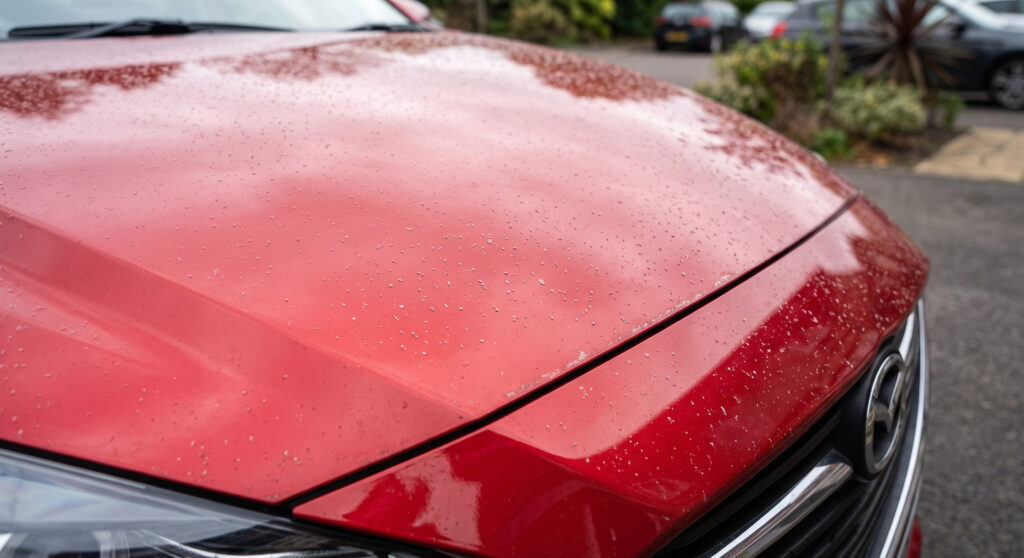
Type 1 spots are fresh mineral deposits just sitting on top of the coating, not bonded into it. These wipe off pretty easily with the right cleaner and a microfiber towel, no polishing required. Most spots people notice within the first week or two fall into this bucket.
Type 2 spots show up when mineral-heavy water dries repeatedly in direct sun or high heat, or when the water itself skews acidic or alkaline, think acid rain, sprinkler runoff mixed with lawn fertilizer, or hard well water. Over time this can lightly etch the coating, and in worse cases, the clear coat underneath. You’ll notice these because they feel slightly rough under your fingertip and a simple wipe won’t touch them.
A few things tend to cause both kinds, over and over:
- Washing or rinsing the car in direct sun or on a hot panel, heat speeds up evaporation, so minerals bond before you’ve had a chance to dry anything off
- Hard water from a hose, well, or municipal supply loaded with dissolved minerals
- Sprinkler overspray, which hits cars repeatedly with mineral- and fertilizer-heavy water that’s left to dry on its own
- Rain that dries in the sun before anyone wipes it down, it picks up pollutants and dust on the way down and behaves a lot like hard tap water once it dries
- Letting the car “air dry” after a wash instead of towel-drying it
- A coating that’s aged past its prime, since the hydrophobic layer wears thin with washes and sun exposure, and droplets stop rolling off the way they used to
- Simply washing less often, a lot of owners let more time pass between washes because the car “stays clean longer,” which just gives any spots more time to sit and etch before anyone notices
How to Prevent Water Spots on Ceramic Coating?
Prevention beats correction every time, and most of it comes down to habit, not products.
Wash in the shade, and don’t stretch it out too long between washes, even a coated car does better with a wash every week or two. Early morning, evening, or a shaded spot works. A hot panel under direct sun doesn’t.
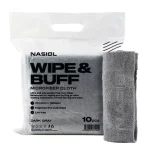
Dry the car by hand after every wash or rain. A clean, plush microfiber towel or a drying blower does the job, don’t let water sit and air-dry, even in the shade. This one habit alone probably prevents more spotting than anything else on this list.
If your water is hard, look into a filtered or deionized rinse. A cheap inline filter on the hose strips out most of the dissolved minerals before they ever touch the paint, and it’s honestly the most effective long-term fix if hard water is your issue.
Watch out for sprinklers. If the car’s parked anywhere near a lawn irrigation system, either move it or rinse and dry it soon after getting hit.
And keep the coating’s hydrophobic performance topped up, it fades with time. A quick maintenance spray or booster every few weeks helps water keep beading and rolling off the way it did when the coating was fresh, which means less water sitting around to begin with.
What Is the Fastest Way to Remove Water Spots?
Whatever you do, don’t reach for dish soap or a generic household descaler under the sink, those can dull or strip a ceramic coating over time, and scrubbing at it risks marring the surface before you’ve even figured out which type of spot you’re dealing with.
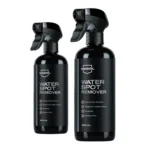
For fresh, surface-level deposits (Type 1), a dedicated water spot remover is the fastest route. Apply it to a cool, shaded panel, wipe it off with a clean microfiber towel, and you’re done, no polishing needed. This is basically the exact job Nasiol Water Spot Remover was built for. It’s a ready-to-use spray that dissolves hard water, salt, and mineral deposits along with light acid rain staining, and it’s safe on paint, glass, wheels, chrome, and matte or satin finishes, so one bottle covers the whole car instead of juggling different cleaners panel to panel. Spray, let it sit a minute or two, wipe, rinse.
For older or etched spots, don’t expect one pass to fix it. A couple of applications can lift progressively more of the deposit, but if a spot still shows a faint outline or feels rough after that, the mineral has probably etched into the surface a bit. At that point gentle polishing, followed by reapplying a maintenance topper, or getting the coating professionally refreshed for the tougher cases, is the more realistic fix.
Two things worth remembering either way: always work in the shade, since heat makes the remover dry too fast to actually do its job, and rinse the panel afterward so nothing’s left behind to dry into a fresh spot.
The Bottom Line
If your coated car is still getting water spots, the coating isn’t the problem, it’s doing exactly what it was designed to do, which is cut down contact time and make cleanup easier, not erase minerals from existence. What you’re seeing is really a water-quality and drying-habit issue more than anything else. Dry the car properly, don’t let water bake in the sun, keep the coating maintained, and jump on any spots before they’ve had time to etch. Stay on top of that and the gap between “this coating isn’t working” and “my car actually looks like a ceramic-coated car should” closes pretty quickly.